Monday, October 3, 2011
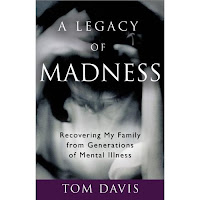
BOOK RELEASE TODAY: An excerpt from A Legacy of Madness
Monday, May 23, 2011
A Legacy of Madness is now in the editing phase
Tom Davis's book, "A Legacy of Madness: Recovering My Family From Generations of Mental Illness," is now in the editing phase.
The website can be found here. Also, feel free to friend and follow the book on Twitter and Facebook.
The book, which will be released Sept. 1, 2011, is available on Amazon, Barnes and Noble and Borders' websites for pre-order. Amazon describes the book thusly:
"Dorothy Winans 'Dede' Davis had worried, fussed, and obsessed for the last time. Her heart stopped beating in a fit of anxiety, soon after her wobbly legs gave way. In the wake of his mother's death, Tom Davis knew one thing: Helplessly self-absorbed and severely obsessive compulsive, Dede led a tormented life. She had moved from nursing home to mental institution in recent years, but what really caused her death?
Posted by
Tom Davis
at
8:40 AM
0
comments
Wednesday, March 23, 2011
Date for Tom Davis's book, "A Legacy of Madness," has been pushed up to Sept. 1
By SUSAN DOWD STONE
Featured Blogger
The release date for award-winning journalist Tom Davis's book, A Legacy of Madness: Recovering My Family From Generations of Mental Illness, has been moved up to Sept. 1.
Davis, who created this blog, has been writing about psychiatric issues for years. His first-person accounts and interviews with those who have suffered from chronic mental illness are deeply moving and realistic.
The book is available through pre-order on Barnes and Noble and Amazon.com.
Posted by
Tom Davis
at
7:43 AM
1 comments
Labels: COPING with obsessive compulsive disorder, Jersey Shore News, Legacy of Madness
Wednesday, March 9, 2011
Tom Davis set to release "A Legacy of Madness" on Oct. 3
By SUSAN DOWD STONE
Featured Blogger
Award-winning journalist Tom Davis, who created this blog, has been writing about psychiatric issues for years. His first-person accounts and interviews with those who have suffered from chronic mental illness are deeply moving and realistic.
The book, which is available through pre-order on Amazon.com, will be released Oct. 3.
Through his website, Coping With Life, visitors leave with an indelible understanding of the experience of mental illness through the voices of those who are challenged to manage its symptoms, interact with our mental health systems and deal with the chronic, unmitigated stigma, which can become, unto itself, a daunting recovery task.
Last year, Tom received the Golden Bell Leadership Award from the Mental Health Association in New Jersey. He was one of only six people in the nation to have received The Rosalynn Carter Mental Health Journalism Fellowship in 2004. He taught a groundbreaking course on Mental Health Issues in the Media at Farleigh Dickenson University. He has written consistently about postpartum-depression legislation and frequently invites guest bloggers to post on the topic.
With the publication of his new book, A Legacy of Madness, Tom extends his powerful advocacy force to the world of print publications.
Following is an excerpt about A Legacy of Madness:
“Dorothy Winans 'Dede' Davis had worried, fussed, and obsessed for the last time. Her heart stopped beating in a fit of anxiety, soon after her wobbly legs gave way. In the wake of his mother's death, Tom Davis knew one thing: Helplessly self-absorbed and severely obsessive compulsive, Dede led a tormented life. She had moved from nursing home to mental institution in recent years, but what really caused her death?
The story of a loving family coming to grips with its own fragilities, A Legacy of Madness relays Tom Davis's journey to uncover, and ultimately understand, the history of mental illness that led generations of his suburban American family to their demise. Investigating his mother's history led to that of Davis's grandfather, a top administrator at one of the largest psychiatric hospitals in the country; his great-grandfather who died of self-inflicted gas asphyxiation during the Depression; and his great-great grandmother who, with her eldest son, may have helped complete two suicides one tragic day.
Ultimately, four generations of family members showed clear signs of depression, obsessive-compulsive disorder, and alcoholism—often mistreated illnesses that test one's ability to cope.
Through this intimate memoir we join Davis on a personal odyssey to ensure that the fifth generation recover their family legacy by getting the help they need to lead healthy, balanced lives. In the end, we witness Davis's powerful transition as he makes peace with the past and heals through forgiveness and compassion for his family and himself.”
I have preordered the book with the knowledge that this will not be an easy weekend read.
Instead, I expect to be profoundly moved by the kind of courage and honesty unique to someone whose knowledge of such issues goes beyond textbooks and clinical practice and comes straight from his own soul.
He writes about families you may know.
There are echoes of my grandmother who "fell on her head" - the explanation given for the dark moods and incredible rages that alternated with periods of engaging warmth, Canasta, Red Sox games and Brighams ice cream. You may recognize your brother, your uncle, or your cousin in his words.
You may recognize yourself as someone who has suffered, struggled or seeks to reverse a mother-daughter impasse which remains unresolved despite generations of pain.
Tom brings to light the accumulation of family trauma that can result when mental health issues remain unaddressed across lifetimes. But the book ultimately brings a transformational hope to those who seek a different outcome.
There are hundreds of websites where you can find information about signs, symptoms, treatment centers, complementary medicine and medication for mental illness. But there are very few online or print refuges where you can spend time with individuals who have suffered chronic mental illness and come to a compassionate understanding of its total impact.
With depression stealthily advancing to the number one position of world health crises, such understanding cannot be postponed any longer. It is time to mitigate and reverse the widening ripple of often generational transmission of mental illness and its devastating long term effects.
Tom's book, A Legacy of Madness, takes on this challenge.
Posted by
Tom Davis
at
10:39 AM
2
comments
Labels: COPING with general mental health issues, COPING with life (Susan Dowd Stone), COPING with obsessive compulsive disorder, Legacy of Madness
Thursday, December 30, 2010
What I've learned
Almost five months have passed, and I've done my best to move on with my life after so many years of doing the same thing.
Ironically, moving on, and doing something else, also meant reconnecting with the past.
The first was my job, and leaving behind The Bergen Record to become the Jersey Shore regional news editor for Patch.com.
I never thought I'd ever see myself at the shore again, other than quick visits to Sandy Hook. But here I am, publishing old photographs of me standing outside the charred remains of the OB Diner in 1989 in Point Pleasant Beach, N.J., or pointing at the fallen garage doors of a landmark bar at Jenkinson's Beach and Boardwalk, also the victim of a 1989 fire.
Or there I am, standing in the front yard of our Point Pleasant house, with my arm around my brother, flashing a wide smile.
I also have a publisher, Hazelden, that has agreed to publish and distribute my book on mental illness by the end of next year. The book will explore the history of my family, and its connections to OCD and other disorders.
That, too, has led me to sift through old photographs - many of which were shot before I was around - and reconnect with my family's past, way back to when my grandfather was the personnel director at Greystone Psychiatric Hospital in North Jersey, and was a sufferer of OCD himself.
I've felt so much more inspired as a writer, because now I've been given license to talk about myself and the things that matter most to me: Family, hometown and history. At Patch.com, I've written about that history for my column, Shoreview.
Four months into this, the ideas never stop.
Shoreview: A Point Pleasant Story
Back in the 1980s, at Rutgers, I was the Jersey Shore kid. I was asked so many questions about it that I sometimes thought I was the only Jersey Shore kid.
My answers, however, were always so lame. I never had an exciting story to tell. What I had to offer was always more goofy than glamorous.
Ultimately, everybody probably thought I was the only Jersey Shore kid who was dull.
"You're from the Point Pleasant?" they'd say. "Do you surf?"
"Sure," I'd say. "Poorly."
"Wow, but, you live at the Shore," they'd say. "You must have a lot of money."
"Well, no," I said. "My father had to work as a bartender in the summer because he couldn't make enough as a principal."
"Oh...," they'd say. "I bet you're a great swimmer."
"Actually," I told them, "I took three swimming lessons at the River Avenue beach, and failed all three of them."
"Oh, OK."
"The teacher once got so frustrated with me that he picked me and threw me into the water..."
"OK, that's good...."
I'd try to spice it up. Yeah, we swam—at Sportsman Island in Brick, or in the Manasquan River at the end of River Avenue, because Jenkinson's was often just a little too crowded.
The sand was always a little too itchy. When I got older, my stomach could never handle too much booze, so I sipped Budweisers and chugged sodas while I watched everyone around me get plowed at Martell's Tiki Bar.
Yeah, I worked at the beach. Only I was running rides on the boardwalk and wearing an ugly green shirt with food and grease stains; not OP shorts with a shirt from the Brave New World surfshop.
I had a tan, yeah, but not a sexy Tony Hawk tan. My tan was a shirt tan.
Yeah, I fished. Caught some fluke once in the Point Pleasant Canal. But my mother made me throw everything back. I guess you could say we "fished for sport."
The more I talked, the more you could see the disappointment sink into their faces. Girls would hang out in my room and ask these questions, all excited to hear me speak. Then they'd slink away when they found out I was, well, no more exciting than they were.
Isn't that just like some people, though? They just don't get it. What they didn't get is that what we lacked in wealth, we gained in the richness of life.
What they didn't get was that Point Pleasant Borough—or "Point Boro," as it's known—is like many other well-preserved towns in New Jersey. Sure, it doesn't have a glamour of a place like Hawaii or Florida. It's too cold between September and May to be a destination resort.
But I'd always choose it first. It's a place that, after many years away, you could still come back and call it your own.
It always was—and still is—a close-knit community, a town that cares about its football, its small businesses and its people. Point Boro is a town that has a main street—Bridge Avenue—that is really a patchwork of small strip malls. But it's simple, and everybody knows where everything is.
We had one high school, a middle school and two elementary schools, allowing many of us to grow together from kindergarten to high school graduation, and beyond.
The class leaders are now among the town's leaders, and they've carried that "Panther Pride" with them from the Student Council and National Honor Society to the Borough Council, Planning Board and the Chamber of Commerce.
My family's Barton Avenue house (see picture) was knocked down soon after my mother's death in 2003. But I guess I qualify as one of those people, too, who resisted temptation and stuck around, or came back after getting a taste of glamour that the rest of the world supposedly provides.
After years of reporting that brought me to places as far and disparate as Afghanistan, I'm excited to be back, and to have come full circle since my buddy, Bill Borden, and I were editors of our high school newspaper, The Panther Print, 25 years ago.
I'm the regional editor for Patch's Jersey Shore news, and I'm proud to be back here, and to have the capacity to bring news back to Point Pleasant Boro and Point Pleasant Beach in a way that, many would agree, hasn't been provided in a long time.
Over the past two decades, I thrived on breaking news stories and covering political scandals involving wayward governors and brazenly corrupt public officials.
I felt the sting and the pain that thousands - even millions - felt as I watched the World Trade Center lay in ruins back in 2001, and then later, when I saw the remains of the victims as the towers' parts and pieces were transported to the Fresh Kills Landfill in Staten Island.
I appreciated the excitement of the reporting world, and I'll miss the glory of writing stories that could shake up an entire state. But I'm glad to be back here, in this understated paradise, where I hold my weekly staff meetings in Pat's Pizza on Route 88, and greet my school classmates who always, every Friday, stop by for a slice.
Growing up, we had the Boardwalk nearby. Yeah, we surfed. But much of that stuff happened in Point Beach, or "the Beach," the Point Pleasant with the ocean view.
What many didn't know, or didn't realize, is that you could have just as much fun slightly to the west, in the "Boro," just being kids.
You could have just as much fun sucking down 32-ounce "Big Gulps" of Coke at 7-Eleven on Bridge Avenue, skateboarding in the parking lots of those same strip malls and hanging out in a treehouse that was hidden in the thick patch of woods at the end of Dorsett Dock Road.
When we were young, many of our roads were dirt. Acres of land were covered with maple, cedar and pine trees, shadowing the swamps where the now-endangered "Pine Barrens Tree Frog" lived in peace, and with a buffer.
We enjoyed being with our families and reslished the idea that our town was so far removed from the troubled neighborhoods of the north.
A bunch of people wrote in our senior-year yearbooks, back in 1985, that they wanted to leave and live in Californa, Florida or someplace "cool." They wanted to get away from the place that, sure, had a beach, but was never really something they wanted, desired or dreamed for.
But many of them came back, or they never left, because they realized that the best place to live was the "Joisey" seashore town with the pizza joints, bait-and-tackle shops and the still-unpaved stretches of land that, in essence, never really changed.
My family lived in a Levittown ranch that, back in the 1970s, had a sesspool in the backyard bubbling every time the toilet flushed. That surely doesn't happen anymore, but the ranches are still there, blending in with the dwindling pine trees that once filled the area.
One of the biggest moments of my childhood, down on my Barton Avenue block, was when they brought in the sewer pipes so everybody could flush their toilet without a worry. But it was also cool for a kid to have these big, hulking cement tubes laying around, waiting to be sunk into the ground. You can do some pretty cool skateboard flips in those things.
One kid from my block would skate almost to the top, flip his board around, zip to the other side of the pipe and do it again. He zipped back and forth, like he was riding a skateboard in a swing, and attract a crowd of kids who would lay their boards on the street, sit on them and watch for hours on end
I'd tell this story to the Rutgers folks and they'd raise their eyebrows, and act like I grew up in the swamps of Mississippi.
No, I'd tell them. Sure, it wasn't Hawaii. It wasn't even Florida or California. But it was - and still is - paradise.
For more, read HERE
--------
Something other than Snooki
I'd tell people I was from the Jersey Shore and I always got the same look. Suddenly, they saw me with one hand on a surfboard, and the other flashing that pinky-and-thumb, Sean-Penn-inspired "gnarley" sign-thing.
"Wow...surfer...waves...RonJon..." they'd utter.
Puh-lease, I'd think. I was a ride operator and a french-fry hack at seaside snack bars. I picked up dug-into-the-sand cigarette butts with my bare, blackened hands and tossed them away for $1 an hour.
To me, standing on a surfboard was like standing on a tightrope. Krazy-glue and staples couldn't keep me on top of those things.
Yeah, I've always loved the beach. But, when I was young, I found the beachgoer image so, dare I say, ugly. Sand stuck in my bathing suit. Wet shoes. Wet, sticky hair. Sand, sand, sand...
That, and the image I had of half-naked people boozing it up at Marz, Cheers, Tradewinds or any of the local bars and clubs - the Snookis before there was even a Snooki, if you will - were enough to make me want to live the rest of my life in my bedroom, flipping baseball cards and listening to Lez Zeppelin on my Sony Walkman.
Ah, if only it was yesteryear. Saying you're from the Jersey Shore, 25 years later, means something completely different, and maybe even something worse. The responses make me want to grab a board and "surf main."
"Do you ever watch......the Jersey Shore?" they always say.
My response?
"You've got to be kidding me."
Now, let's face it: I can't blame people for following the summer-goings-on of DJ Pauly, Angelina and JWOWW (did I spell that right?) anymore than I can blame people for slowing down on the Garden State Parkway to leer at an overtuned tractor-trailer.
But what bothers me, again, is the image. The image I want of the Jersey Shore is, frankly, something closer to the laid-back, surfer-dude impression that forced me away as a kid, but I now embrace.
That's the image I want in my mind, and I hope it stays that way, long after the Jersey Shore MTV show burns out and seeps into the pop-culture landfill, just underneath "The Macarena."
That's the image I want for Patch.com, and how I want it presented in the news coming from Long Branch, and Manasquan, as well as the news from Toms River. I want the balance of trouble and tranquility, whether it's in the form of Brick Township news, Berkeley Township news, Manchester news, Wall Township news or Howell Township news.
I want the news of balance, and balance is what Jersey Shore news, and its image, is supposed to be about. It's not just about Snooki, and not just about trouble. The Jersey Shore is tranquil, serene, fun and family-oriented.
The image I prefer is the beach that can be crowded, sure. But, at dusk, or in the fall, it's a peaceful place, with water that washes in and out, and a little pond forming for kids to play in.
It's a place to party, sure. There are the bars and boardwalks in Long Branch, Asbury Park, Manasquan, Belmar and Seaside Heights, and plenty of news from those towns, too. But it's not all about the booze and the beer. It's about the volleyball, the surfing, the football-tossing and the kind of fun, family stuff that still attracts the singles as well as the family guys, just as it has for more than a century.
You see it in Brick, Toms River, South Seaside Park and Point Pleasant, where the local townfolk have kept the cottages and family restaurants that cater to those who preserve rather than destroy.
In Manasquan, there's Gee Gee's, where burgers are still broiled on a grill, not fried on a large, greasy plate of steel. The fries come with a pound of cheese dumped on them, wrapped in a healthy-sized piece of aluminum foil.
In the arcade, people can play the games that got us into video games in the first place; not the swinging cranes that tease us every time, and always fail to pick up the large, stuffed Stewie from The Family Guy.
The boardwalk has no boards; just a paved path that starts and ends in Manasquan, lined with cottages that overlook the waves that roll in and out, all day long.
It's also in Long Branch, one of the last Jersey Shore communities to be nearly free of the commerical boardwalks, booze and bad boys that have made the region a punchline.
In Long Branch, there are high-rise hotels and apartments, private beaches and parking lots. But there are few bars and even less fights that have made for quite a plot-line on the Seaside-Heights-based MTV show.
In Long Branch, there's still the "Wind Mill" - the original one, with the actual wind mill hanging from the peak of the pointed-roof, and the window seating next to a door that never stays completely closed, letting in a gush of cold air every five minutes. The fries are still crinkly and the hot dogs are bigger than my hand.
There's Max's Hot Dogs, once a 25-seat hotdog stand in 1928 that has evolved into a 200-seat full service restaurant that offers "favorite American delights for everyone," according to its wesite.
There's "Freeloaders Beach," which ain't free anymore. You used to be able to sneak on there and nobody ever bothered. But the flat, soft sand that's carved under a sand ridge is still a great place for surfers, especially during the hurricane season when most of the tourists stay away.
And many still get on for free (sshh!).
Some of the good haunts are gone. A friend of mine and I used to go to "Cheers" nearly every week. We kept hoping we'd see Bruce Springsteen - he supposedly wrote the "Thunder Road" lyrics and the "Born to Run" words and music in Long Branch - and kept wishing he'd pop in on Bobby Bandiera, a guitarist with Southside Johnny and Asbury Jukes.
He never did, at least when we weren't there. But we did get some 80-year-old guy who'd sing "Kansas City" as Bandiera strummed away.
The bar and the old guy are gone. But the beach and the boards are still here, throughout the year. Cold and rain are no reasons to stay away; that's what a wet suit is for.
Here, they take the surfers over the Snookis.
For more, read HERE.
--------
Shoreview: A Howell Story
I was the happiest guy to ever finish seventh place.
Fifty yards ahead of me, with about 100 yards to go, was Mike Devlin, the fastest guy on the 1983 Howell Township Cross-Country team. My fiery coach at Point Boro High, his face beet-red and his soiled eyes leering at me, pointed at Mike's backside and fired off an order.
"Go get him!" he yelled. "Beat him, and we get the shut-out."
I did.
When Mr. Seyfried barked, you bowed. When he wanted speed, you spun.
Soon, the distance was 40 yards. Then 20, and 10. With just 20 feet to go, I lunged past Mike, head and all, and stretched out a split-second advantage for myself. I probably saw too many of those photos of Jesse Owens from the 1936 Olympics, thinking I could lunge, run and win, just like Jesse. It worked.
I was always hoping I could win something. Anything. Before then, I didn't win much. I didn't get the girls. I got picked last in kickball. I got cut from the baseball team. I got cut from the basketball team.
That day, on Oct. 18, 1983, in Howell, I did. Yeah, it was seventh place. Yeah, I didn't really win. But it was a triumph, and it was my first real one. Whenever I'm tested, I think back to that day, at Howell Township High School, when a little extra effort went so far.
Whenever I'm behind, I think of Devlin's backside, and I remember how I caught up, and passed him at the end. I think of that extra "oomph" I had in my steps—the extra juice of adrenaline that made me catch up, and launch into a fully loaded sprint.
I didn't win, but I did preserve Point Boro's shutout, a 15-50 clobbering of Howell where the top seven runners were all from the same team. That team was ours, and I was seventh.
Whenever I hear of sports, and how people want to cut them, or reduce the funding so the sport is reduced to something meaningless, I wonder: If they could only feel what it's like to be 50 yards behind somebody, feeling helpless, only to conjure enough spirit in the last seconds to triumph.
When I did it, it became something so memorable, even 27 years later, with my best running days behind me.
I always wanted some taste of victory, the kind of success that others enjoyed. I was always hoping I would be faster. Sure, I did well in school. But sports were the social barometer. The better I did, the better things were.
It had little to do with making friends. It had nothing to do with school spirit. It was all about the spirit of the self. It was about finding the ability to achieve.
That spirit carried over into my journalism career. I never had the greatest connections. I didn't have the money to go to the best schools, the ones that pushed people through the doors of Columbia and into the hands of a big-time newspaper.
In my career, everything always seemed to be running behind. Despite the many successes I've had, the newspaper industry has suffered for much of the past 20 years. Many solid reporters have left. News holes have shrunk considerably.
Here, at the Howell Patch, where I'm helping to manage Howell news, I feel like I'm catching up again. With Patch demonstrating the foresight to capitalize in the market of digital journalism, I feel like I'm running ahead again.
Until that Howell meet, at age 16, I had no idea how to summon that spirit. I didn't understand the idea of coming from behind, and succeeding. I watched athletes do it and thought it was something magical. After Howell, I learned something quite different.
For more, read HERE.
--------
Shoreview: A Brick Story
Beyond the tree-lined roads and horse farms, and far away from the traffic that routinely packed the Laurelton Circle, my father made his living, one day at a time.
It wasn't always easy getting out of bed at 5 a.m. every day, for 20 years, and facing a few hundred chatty kids who packed the small classrooms of the aging Herbertsville Elementary School.
Stan Davis was a teacher, then principal of a school that was so crowded, there wasn't enough room for an all-purpose room. Gym class and lunch were always held in the classrooms, right at the students' desks.
But my father got up every day, anyway, for 20 years, and he didn't really ever want to let go of the old-fashioned simplicity that long defined the Herbertsville section of Brick.
"Once in a while the horses would get loose and get on school grounds," he told me recently.
Eventually, in 1983, he would leave to be principal of Drum Point, and then retire 13 years later before settling in Ocean Grove and Manchester. Eventually, we would all leave, thinking our greener pastures were much farther away.
But we never stopped thinking of the trees, the roads, the horse stables and the old school as "home."
Now, as the Jersey Shore regional editor for Patch.com, and with the introduction of this Brick Township Patch site, I'm back. We're back. Now that we're back, I want to give light to a town that - in many places - never lost it's quaint, rural feel and its pleasant, peaceful views along the muddy banks of the Manasquan River.
I want to provide Brick news, Jersey Shore news, that was once provided and defined by people who stayed for years, and who never wanted to go away, either. Don Bennett, who worked for The Ocean County Observer for decades, and Pat Miller, a veteran of The Asbury Park Press, were among those people. Now they work for Patch.
I want to give light to the community my father saw more than 50 years ago, when he chose Brick over schools up north, because there was opportunity for jobs and for raising kids safely that wasn't elsewhere.
"At the time (in 1958), there was a lot of tremendous growth. A lot of the houses were inexpensive," he said.
Yes, Brick will always be known for Routes 70 and 88, as well as Brick Boulevard and Chambers Bridge Road. It will always carry the weight of the suburban sprawl, the corked-up jughandles and cars that clog nearly every interesection, and nearly every highway heading south and west.
For 23 years, the Laurelton Circle has been gone. But the lines of traffic are, on occsasion, still there, occasionally piling back to Kmart, just as it did in the 1970s and 1980s. Drivers still pause with fear as they creep through the remodeled intersection, and get confused as they mix up their 70s with their 88s.
"But it is a lot better now," my father said. "You don't have that congestion you used to have. It used to be terrible there at 4 p.m."
There are still places that remind me of the Brick of my youth. The aging Herbertsville firehouse, where I first saw Santa Claus (and screamed), is still there, too, even though brown, box-like condominiums replaced much of the scenery that surrounded it.
"That firehouse was a meeting place - they used to have to have a lot of social activities there," my father said.
Herbertsville Elementary School is still there, too. Only now it has a remodeled facade, giving it the look of a new school, even if it still has the one-story-high classrooms where my father taught during the 1960s.
And they are still crowded.
A lot of development has come to Herbertsville in recent years. But a lot of what was there, 40 and 50 years ago, has remained. Anybody going there could see why, perhaps, we moved down there in the first place.
They could see a community where my father made his living, and nearby, raised a family who never really wanted to leave, even when our house in Point Pleasant was knocked down seven years ago.
They would get a sense that there is a place where people still live, peacefully and happily, one day at a time.
For more, read HERE.
In Barnegat, I Was No Longer Bored
Just four years into my career, I already thought reporting was boring.
I was a guy with a writing pedigree who broke big stuff while working as a top editor at the Rutgers University paper, The Daily Targum. My girlfriend liked my writing so much that she'd sit in my New Brunswick apartment and read my stories aloud.
I hated it when she did that. But I guess she saw something in the cadence and rhythm of the language that was envigorating, because I sure didn't. I was always a little too shy to accept my own attributes.
Out of college, I worked two-plus-years at a small daily in Delaware, then nearly two years at the Ocean County Observer. My cadence and rhythm and writing skills were restricted to stories on council meetings, wastewater treatment facilities and guys who got up at meetings and always had a lot to say, even if the late-night meeting was already three hours long.
I wanted to break out. I wanted to live the life, and live the dream I planned for myself when I was 7, 8, 9, 10 years old. I wanted to be a writer and a reporter, and I wanted to go beyond the confines of a meeting room and write about everybody else.
I wanted to write about their problems...not mine. I wanted to write about their accomplishments, and salute their triumphs. Not mine, and not those of the public officials.
Four days after I was hired The Press of Atlantic City, I got it. I found the Barnegat downtown, down at the east end of E. Bay Avenue. I found my voice. I found my rhythm and my cadence.
I found fun, and I found a reason to stay in this profession, the only one I've ever had.
A committeeman by the name of Kendal Klix, who died three years later of cancer, took me on a tour of the downtown soon after I started at The Press in August 1993. He offered to do it just hours before, and when he did, I laughed. "Barnegat has a downtown?" I asked him.
"It sure does," he said in that western drawl of his, which stood out among his fellow Jersey committee members.
I had worked as an intern and as a full-time reporter in the Manahawkin area for my entire career. I knew what towns were like down in southern Ocean County. I thought I had them covered. I thought they were all like Route 72, or Bay Avenue: suburban sprawl, with houses that had big yards, a Wawa or two and five gas stations, all with a convenience store that sold Beef Jerky and tobacco dip.
I went on the little tour as a get-to-know visit. My expectations were so low that I tucked my pad in my pocket, and got ready to just walk around and listen to the nice man with the drawl talk about something that just wasn't there. Or, perhaps, it wasn't there yet.
I drove up Route 9 north and, following his directions, made a right at Bay Avenue, not a left. I saw a row of old buildings, antique shops and an ice cream store.
I was stunned. I realized, geez, if I had ever made a right on Bay Avenue instead of a left before then, maybe I would have seen this. If I wasn't so hot about getting home every day, and getting to the Garden State Parkway, I could have taken a little more time and seen something new.
Kendal showed me around, and showed me the antique shops that he said would anchor the place. They sold baseball cards, pianos and guitars at these places. I almost bought a guitar with no strings, but I resisted the urge.
The last place we stopped at was the ice cream store, the Hurricane House. I saw what looked liked Gower's drug store in "It's a Wonderful Life." I saw the big silvery levers that served fountain sodas, as well as little wooden tables and drapes cut out of 1910.
"This is one of my favorite places," he said.
Suddenly, I had more than a downtown story, a story about rehabilitation. I had more than a story about a township that was tryng to survive by enhancing its history.
I had history, scenery and setting. I had place and time. I had description, and the background for a story that was lively and engaging. I had an interesting story to tell, one that went beyond something political.
What was really cool was that my paper, The Press of Atlantic City, gave me the space, and encouraged me to be a writer and not just a reporter. The paper that gave me my start as a manager a year later said they wanted more than the briefs and the burrow-pit stories that bored me in Delaware.
The Press wanted "tales," and "break-out pieces" with big pictures, and here was one of my first.
At the Hurricane House, I sat on swivel chair and spun myself around, like I used to do when I visited these kinds of places that were always well-preserved in the older towns of North Jersey, but seemed non-existent at the Jersey Shore. I stared at the wooden tables that were uneven in the legs. I saw "Hurricane House" painted in the windows, fronting the streetside view of antique shops and trees. It made me feel like a hourse-and-buggy was going to pass by at any moment.
I was hooked.
For more, read HERE.
Wednesday, May 26, 2010
The evolving illness
For years, it was called the baby blues. The sadness and illnesses felt by women after giving birth was not even officially listed as an illness.
To this day, no one really knows what postpartum depression is all about.
Yes, advances have been made in the diagnosing of the illness. Yes, the symptoms of depression and psychosis are much more evident than they ever were.
But what can in trigger? The practice of diagnosing some mental illnesses is changing by the year. Schizophrenia, for example, is no longer thought of only something that's inherited.
Illnesses like schizophrenia, however, at least have had the backing of researchers and even some politicians. Now postpartum depression has taken that step with the passage of the MOTHERS act, which will help those diagnosed with the illness to achieve insurance parity.
It will also encourage further research into an illness that had long been ignored until several high profile public figures began to talk about it.
It will encourage people to study cases that are similar to what my mother experienced when she suffered from the symptoms of it in 1967 and 1968.
She refused to leave the house for days, and she went into panic attacks whenever she would attempt to do the normal routine chores of her life.
From there, her mental state evolved, and she developed the full-blown symptoms of obsessive compulsive disorder that ultimately led to her 2003 death.
To this day, we still don't know if there was a postpartum connection to the OCD. Maybe someday we will.
Posted by
Tom Davis
at
7:15 AM
4
comments
Labels: COPING with obsessive compulsive disorder, COPING with postpartum depression
Tuesday, December 8, 2009
Healing thy mother's keeper
I have found the book of my life. And I didn't even write it.
I'm not even half-way done with it, but I feel like it's my story already.
"My Mother's Keeper," by Tara Elgin Holley and Joe Holley, is storytelling that's so vivid that the scenes seem to jump off the page. The descriptions are so effective in stimulating the imagination that a movie seems unnecessary (but I'm sure it could be a great one).
It's the story of Tara's mother, Dawn, whose descent into schizophrenia ended a promising singing career. Tara grows up knowing her mother, but not really knowing her sickness - not until she was an adult, really, and she tried to care for her, and keep her from being known as the local "bag lady."
It's a book that speaks to the power of words, and how good writing can help heal the wounds of the soul. Writing can be therapeutic not only for the writer, but also the reader - like myself - who can identify with the plight of the characters. In my case, I know them very well: Dawn and Tara's family resemble my own, in a way.
In my case, my mother had severe obsessive compulsive disorder, and lived with it for much of her life. She inherited the family disease, the symptoms for which were evident with my grandfather, great-grandfather and great-great-grandmother. Like Dawn, they battled their symptoms but never really found solutions.
Like Tara and Joe, I'm writing a book about it, and how I dealt with it all and learned from it. The book is entitled "Generations: A Portrait of a Family Struggling with Mental Illness," and I hope to have it done within the year.
In my book, unlike "My Mother's Keeper," the characters meet their demise too early. Suicide lingers in the shadows of my family, because it's how my great-grandfather, and possibly my great-great-grandmother, ended their lives. With my grandfather and mother, it was self-destruction through alcoholism and personal neglect.
But it's the kind of book that provides validation for your life. When you read about Dawn's impact on the family, you realize that you're not alone, dealing with the problems of finding care for a loved one when there really isn't any that is any good, or good enough.
You realize that you and your family, as well your children are susceptible to what seems like a family curse, and to think that is not the product of paranoia. If others suffer this way, so could you. If others could find a way to manage it, and address these issues before they manifest into something intolerable, so could you.
I've stopped writing over the past few days because I need to read this book. I need to see how Tara and Joe did it, and how they mastered the ability to write about how mental illness is not something that's only suffered by the homeless on the street.
It's something that affects people who live in California - where Tara's mother lived, and where Tara enjoyed a family life, and a sometimes stable one, being cared for by her grandparents before her mother was committed to a psychiatric hospital and her conditioned worsened.
It certainly affects people in Point Pleasant, N.J., a suburban bedroom community at the Jersey Shore, where I grew up, and dealt with my mother's symptoms of OCD most of my life.
There, in 2003, my mother passed away after a fall. She was heading toward the bathroom, worried that her chest felt tight and she was short of breath. The bathroom was where she often went in times of crisis, and she spent hours in there, washing her hands until they were red, and the skin peeled off. But she never made it; she collapsed on the couch, about 30 feet short of her goal.
In that same house, just two years earlier, she drank beer until she passed out in a reclining chair, uttering things that were incoherent before she, too, was committed to a psychiatric hospital. When she was committed, my father found cases of beer and boxes containing moldy pizza stuffed in the refrigerator.
Indeed, one of the opening scenes of the book made me feel like I was living it again. This scene was at Tara's apartment, and it was told by her husband, Joe:
It was a warm night, a beautiful night, but as we walked across the yard and stepped onto the porch, we could tell something was wrong. Empty beer cans were scattered about, and as we started to unlock the door, we could see that it had been forced open. I could feel the hair on the back of my neck prickle and my stomach tighten. Was the burglar inside? Did he have a gun? Should we hurry away and call the police?
As we slowly pushed open the door and peered into the darkness of the living room, I smelled the stabbing odor of urine and stale beer and an unwashed human being. In the darkness, I could barely make out someone sitting on the floor, someone mumbling incoherently.
I was scared, but Tara wasn't. She was angry and upset, not scared. She knew who had invaded her home, her well-ordered life. It was her mother waiting in the darkness. It was Dawn.
Like me, Tara loved her mother, and loved being with her, especially when she was young. In the book, she calls her "mommy," just as I did my mother, long after I wasn't supposed to call her that anymore.
But, when she was young, Tara went out for a car ride with Dawn one day, the door flung open, and Tara found herself on the pavement, with scratches and cuts. Or so her memories tell her.
When Tara played hide-and-go-seek with her mother, Dawn disappeared, and didn't reappear for a while. Instead of her mother coming out from behind the tree, and saying, "Here I am!" Dawn was gone.
Tara found herself in the police station, sitting on a counter top, eating ice cream, waiting for her grandparents to take her home.
The moment reminded me of the time I was 10, and I was chased in a department store by a woman who tried to stuff me in her overcoat. She chased me to the parking lot, and I hid between the cars while she looked for me. Finally, after looking for a good 10 minutes, she walked away and I warily walked back inside.
I found my mother looking at the clothes, the same clothes she obsessed over, and bought so many of them that she stuffed her closet, nearly breaking the sliding door. She had left me alone, in the book section, while she spent nearly an hour looking and trying on the same clothes, over and over. Each piece of clothing wasn't just the right fit....or maybe it was, she'd think, and she'd ask to try them on all over again.
I said to her, "Mommy! A woman just chased me around the store!"
"Oh, really. Wow," she said, half-interested. "Are you all right?"
"Yes," I said.
"OK, well I'm going to buy these clothes," she said. "You wait here while I try them on."
Then she left me along again, standing in the women's clothing section, feeling like I could be snatched at any second.
When Tara went to live with other relatives, she traveled with her mother from Hollywood, taking a long bus ride to Houston. It would be her last sustained experience with her mother, who would be taken away from her once they arrived.
From then on, Dawn would shuttle in-and-out of psychiatric care and institutions for the rest of her life, much as my mother did when her symptoms of obsessive compulsive disorder worsened.
With every passing chapter, right up until Dawn grew old, and preferred living on the street, selling cigarettes, Tara offers a voice of frustration, but also a proclamation of love. She always kept her mother's within her grasp, and she was always ready to save her from whatever embarrassment she might cause, and she was ready to defend her whenever she was mocked or mistreated. She was always ready to commit her whenever she was a danger to herself, but she also realized that she could not always stop Dawn from being Dawn.
At the heart of my book is my mother, and how we showed our love in a similar way. In my mother's final years, we couldn't get close to her because she was afraid of our germs. She wouldn't let us kiss her unless it was all the way under ear, where her skin was red and chapped from the constant washing or her neck and face.
But we did the best we could, and like Tara, we tried to stabilize and comfort her life. We always wondered if we didn't do enough, even at the end, when we finally addressed my mother's battle with OCD after years of neglect, but it just seemed too late as her physical health declined.
Six years later, after reading Tara and Joe's book, I realize now that, perhaps, we did what we could do.
Neil Young/Heart of Gold
I want to live,
I want to give
I've been a miner
for a heart of gold.
It's these expressions
I never give
That keep me searching
for a heart of gold
And I'm getting old.
Keeps me searching
for a heart of gold
And I'm getting old.
I've been to Hollywood
I've been to Redwood
I crossed the ocean
for a heart of gold
I've been in my mind,
it's such a fine line
That keeps me searching
for a heart of gold
And I'm getting old.
Keeps me searching
for a heart of gold
And I'm getting old.
Keep me searching
for a heart of gold
You keep me searching
for a heart of gold
And I'm growing old.
I've been a miner
for a heart of gold.
Posted by
Tom Davis
at
5:00 AM
1 comments
Labels: COPING with obsessive compulsive disorder, COPING with schizophrenia
Wednesday, October 14, 2009
Hope isn't a dangerous thing
Every time I hear of more job losses, or I see more reports of a failing economy, I think back to when I was a kid, and I had dreams of being a best-selling book author by the age of 23. Or I was going to make enough money to buy the Mets and turn them into the Yankees, and spend my senior years in a box by the dugout, with my feet up on the orange Shea Stadium railing, admiring my World Series rings as they glistened in the Queens sunshine.
I was going to make enough money and give it to my brother, the scientist, so he could find a cure for my mother's obsessive behavior. I was going to buy a big house and have round-the-clock nursing care that would give her the relief and the medication she needed. And she would go along with it, of course, because this was only a dream.
Or maybe I was going to be president and run in the 2004 election, as an independent. I was going to get elected as the youngest president ever and solve everybody's problems, because I was independent.
I was going do it without the influence of money and greed, and I was going to resist the John-Edwards-like impulses of narcissism. I was going to run a country based on the same principles that John Adams and Thomas Jefferson wrote about in either the Federalist Papers or the Declaration of Independence.
I could have that dream because, I knew, as an American, I lived in a country where power is shared, not consolidated.
I knew that as an American, I was lucky, and good enough to be born in a country that didn't have poverty and disease like they have poverty and disease in Africa. I knew I could get a job, and I'd have an opportunity to live a life that was something close to my dreams, even if I didn't get everything that I wanted.
But with every bad thing coming out of Washington, and every little nasty political attack I hear on the radio or I see on television, and every bit of talk about credit and jobs drying up, I wonder if everything I hoped for was just that: a dream.
I wonder if I'll ever have anything close to not only what I not wanted, but what I expected. I always expected big things for myself, and I believed all the things my guidance counselors and my parents said about me. But when I look at my profession, and I see newspapers vaporizing, I sometimes wonder if it's a dream that's going to waste.
I have to stop myself, and remind myself that America, yes, is a land of dreams. But it's more a land of hope. I'm 42, and I could still live some or all of my dreams. Without hope, however, I never would have survived.
I never would been able to deal with the struggles I had early on, when I worked for The Delaware State News and a ring of reporters who were jealous of my salary conspired to get me fired. I never would have sought help when I needed it, and turned to a food pantry in 1990 because I couldn't afford to buy anything more than a 79-cent taco at Taco Bell for dinner.
I never would have maintained the friendships I've had, because I've always believed in the people I trust. Even when they've driven me crazy, I always knew there was good in them, and even if they did something wrong, their intentions were right.
I never would have been able to run five miles in 33 minutes and 26 seconds, as I did last week, despite being 42 and long past the prime of my athletic life.
I never would have raised the family I've raised, with an utterly tolerant, open-minded and beautiful wife who has been my saving grace. For that, I am not only hopeful. I'm thankful.
I'd like to think that, if this were 1989 again, and I had the opportunity to look into the future, I'd say I had a life worth living. I didn't know this then, but I know it now: I'll always have the strength and desire to live through the struggles, because I've done it before. As long I'm healthy - not just in body, but in spirit - I'll do it again.
Twenty years ago, on the day I graduated from Rutgers University, I started my first job. I piled my clothes in my back seat, rolled down the windows of my Dodge Dart and drove from New Brunswick to South Brunswick, N.J., with the hot sun rays shooting through the front windshield. I had no air conditioner, so I couldn't stop sweating. I had no FM radio so I couldn't really listen to music.
"Don't worry about it," I thought to myself. "It won't always be like this."
But a song kept repeating in my head, and its meaning was magnified with every pang of nausea I felt in my gut as I felt anxious about a career not yet started. I felt anxious about a newspaper industry that was taking it on the chin, just like it's taking it on the chin now.
Twenty years later, the song never really left, and every now and then, I still hear the strings of the acoustic guitar at the song's opening with every bit of bad news not just about the newspaper industry, but also America.
It was that John Mellencamp song, "Pink Houses," and there was a line in there that seemed to say everything about my life then. More importantly, it says something about our lives now.
Well theres a young man in a t-shirt
Listening to a rockin' rollin' station
He's got a greasy hair, greasy smile
He says: Lord, this must be my destination
'Cuz they told me, when I was younger
"Boy, youre gonna be president"
But just like everyting else, those old crazy dreams
Just kinda came and went
"Ain't that America" he says. Ain't that America, for you and me.
I love that song, but not because it's a song of failed dreams. Behind every lament, I believe, is a feeling of hope.
I believe that Mellencamp saw his song as a message. He believed that lives could be turned around, and not left to die. He saw the farms diseappearing in the Midwest during the early 1980s, and he hoped that people would hear his song, and come to their aid. And they did.
Every time I hear a cry of panic about America, I hope it's not political posturing. I hope it's about hope, and bringing attention to the problems that exist in this country, a nation that's established and strong but young enough to evolve and improve.
I think of The Shawshank Redemption, a movie about inmates at a prison who felt institutionalized by their lives. I remember the scene when the character "Red," played by Morgan Freedman, told his friend, Andy, that hope is a dangerous thing. It could drive a man insane, he said.
Andy, played by Tim Robbins, later broke out of jail and essentially cleared his name. He wrote Red a letter, which Red read when he, too, was able to leave the notorious prison.
"Remember Red," he wrote. "Hope is a good thing, maybe the best of things, and no good thing ever dies. "
Posted by
Tom Davis
at
12:40 PM
3
comments
Labels: COPING with general mental health issues, COPING with obsessive compulsive disorder
Tuesday, July 28, 2009
My great uncle, the wallpaper hanger
I first learned I had a great uncle named Frederick when I visited my family's Hillside, N.J. cemetery plot last November. His tombstone had been pulled from the ground and tossed to the side. The family headstone had fallen on the ground, and was laying on its face.
It was like standing outside an abandoned restaurant and trying to figure out what was on the lunch menu. I had little hope that I could draw anything from this decrepit scene.
But a visit to the graveyard office, and a death certificate from California gave that ugly scene some meaning. In fact, it was downright symbolic.
At the graveyard office, I learned that Frederick died of gas asphyxiation with his mother, Lydia, on Oct. 4, 1928. Their deaths weren't ruled a suicide, though the circumstances seemed strange and suspicious. Five years later, Frederick's brother, Edward, died the same way.
I later learned that Frederick led a rather undistinguished life, working for his Civil War veteran father as a "wallpaper hanger" and as a clerk for his brother, Edward, who was my great-grandfather.
Then, three weeks ago, the death certificate for Frederick's oldest son, Clarence, arrived in the mail - three months after I asked for it. The informant was his son, Donald. We talked, and the flood gates opened.
I learned that Frederick was married. I learned that his wife, Matilda, up and left in 1915, taking the three children to California and leaving Frederick behind, alone.
I talked to Frederick's great-granddaughter, Sharon Winans Pearson. In that conversation, I learned what I long suspected. Frederick, most likely, was another symbol of the long history of mental illness in my family.
Sharon did a great job in filling in the holes in Frederick's life that came as no surprise. Here is what she wrote:
Matilda married Frederick Winans on June 29, 1892. Frederick's father was of English-Dutch origin and his name may have been Winant. Unfortunately, Frederick was not home very much. Rumors tell us he had an alcohol problem. Therefore Matilda was on her own to raise the three children:
1. Mabel, born 1893,
2. Clarence, born 1899, and
3. Merrill, born 1907.
To support the family, Matilda ran a two-story boarding house in Elizabeth, N.J. Although Matilda may not have visited church on a regular basis, she did attend certain events. Merrill remembers his older sister helping him get dressed and ready for these special occasions. Family documents show Matilda was baptized and married at Christ Church (Episcopal), in Elizabeth.
In the early 1900's it was customary for wealthy women to have a seamstress come to their home for a period of time, and live with the family. Matilda, who was an excellent seamstress, was able to secure jobs of this type and would stay with families for extended periods. Young Merrill, who was probably under the age of eight at this time, accompanied his mother. Many of these homes had beautiful gardens and Merrill would often be sent outside to play. As he wandered along the pathways he began to develop an interest in planting his own garden. Later in life Merrill would excel as a landscape architect.
It was not uncommon for young boys to be at the train station (see above picture). One could find out the latest news, pick up the family mail, and watch travelers from far away places bustle back and forth across the streets. One day Clarence pulled Merrill in a wagon along the busy street, when suddenly he stopped and pointed toward a man in the distance.
"Merrill," Clarence said, "That is your father."
This is Merrill's only recollection of his father.
Posted by
Tom Davis
at
5:03 PM
1 comments
Labels: COPING with dual diagnosis, COPING with obsessive compulsive disorder
Wednesday, July 22, 2009
A break, coming out of nowhere
In every family, there's always some guy who comes out of nowhere, who doesn't seem to have any connection to anybody other than blood.
It's the guy who lives a mysterious life that sparks curiosity, but he disappears before he yields any clues.
Researching for my book, "Generations: My Family's Struggle with Mental Illness," I came across a great uncle by the name of Frederick Winans who apparently gassed himself on Oct. 4, 1928.
I never even heard of him until I saw his gravesite last November, and I discovered that his tombstone had been pulled off his gravesite and turned upside-down.
He, his mother and his dog died all at the same time, making front-page news in the Elizabeth Daily Journal the following day.
Later I learned that he was a "wall-paper hanger" who was married to a woman named "Matilda." She left him for California, it appeared, with their three children.
He just seemed to represent another layer of misfortune in a family with several generations of mental illness and alcoholism. But even that wasn't a guarantee since his death wasn't officially labeled a suicide.
Frederick is the one guy who could make or break a book. He's like a big hole in a story that can't be ignored.
He's not absolutely central to the plot of the story. But knowing a little more about him could provide some inspiration.
And his story, however benign or bizarre, could make the entire book that much more attractive to picky publishers.
Last week came a break. A death certificate for his son, Clarence, arrived in the mail, two months after I requested it from the state of California.
I discovered family names I never heard of. I called Frederick's grandson, Don, and we talked for an hour. He confirmed everything: Frederick went into the Navy, and then disappeared after he split up with his wife. Matilda went to California to start anew.
Guess what? Mental illness and alcoholism runs in Don's family, too. So does intelligence - Don helped design the Hubble telescope. His uncle was a landscape architect.
Hopefully, that's just the start of a new chapter.
Posted by
Tom Davis
at
2:36 AM
0
comments
Tuesday, April 14, 2009
The good life, in Florida (the story of my grandfather, part III)
At 63, Dick Winans finally got the fraternity party he always wanted.
Away from the office at Greystone Psychiatric Hospital, free from a troubled marriage just months after his wife's 1975 death, he let it go.
Instead of wearing his ever-present necktie and suit, the same he kind his father made him wear when he attended an exclusive private high school in Hightstown, N.J., Dick spent much of the Florida trip he took with us wearing black swimming trunks and showing his hairy chest.
Normally lean, he started to show a belly that hung over the waist band of the trunks.
He dated, and the more he dated, the more he drank. He missed Dorothy, his wife, and he cried at the mention of her name.
But in another breath, he'd call her "bitch" and moan that she left him nothing in inheritance.
We took him on this April 1976 as an act of mercy. We were afraid that, if we left him home, he'd get smashed, hop in the car again, drive the hour drive from Morristown to Asbury Park, N.J. and drink some more.
Just a few years before, he disappeared for a whole day, until he was found in his car in Ocean Grove, plastered.
Another time, he drank all morning before he and Dorothy went out for a drive. They ended up in Asbury Park, where Dick pulled out his camera, and snapped beautiful women.
My sister and I fretted. "What if he goes blind?" we thought. What we should have worried about was Dick pitching back Budweisers and getting behind the wheel.
On a warm day in April, Dick arrived at our house, in Point Pleasant, N.J., wearing a Hawaiian shirt and a bag packed with a storefull of underwear, socks and Vick's VapoRub that he rubbed on the lining of his nose to clear his aching sinuses.
I talked to him at night as he slept on a mattress on the floor of our living room. He tickled me and laughed, and traded knock-knock jokes with me.
I remember feeling surprised. I had heard about him, and always saw him as a straight arrows. I saw him in the photos with the thick eyebrows, and thin grin.
But then I also saw him in photos with my mother, pulling on her pigtails, and smiling. He was devoting the kind of attention that my mother used to give me. In Point Pleasant, I saw that man that I had heard about, but thought was a legend.
We borrowed a station wagon from one of my father’s friends, just so we could fit him. My brother and I switched sitting in the wagon, while my grandfather and Carolyn sat in the back seat.
The man who tickled me at home fell silent. He struggled to engage in even simple chit-chat. When he did try to join in on conversations between my parents, he often got a stare, if not a leer from my mother.
One time she got so upset by his interjection that she pulled off her sunglasses and slammed them in between the seats. Dick leaned back, and returned to saying nothing.
Much like the California trips, the ride was too long. Interstate 95 wasn’t fully built yet, so we found ourselves taking alternate routes in North Carolina and Georgia. Signs for steakhouses would get my mother going. “Please, dear, can we go out to eat?” “Please?”
At every stop, my grandfather drank, sucking down beer after beer. By the end of the meal, he’d be sloshed, and his breath would smell like rubbing alcohol.
Then he would want dessert, so he’d take his knife and bang an empty glass like a bell. “Waitress!” he’d shout. We all wanted to slump in our seats and disappear.
At first, he was like a walking comedy act, quite the reverse of what we once thought about him. By the time we reached Miami Beach, however, he was draining us.
We also knew all the words to the song. Arriving at the LaGorce hotel, finally, we had the same thoughts we had in Los Angeles the previous year. Should we turn back?
Once there, Dick put on a display, unleashing and revealing himself in a way that even surprised his daughter. He traded in his well-pressed-suit look for that of a 63-year-old man trying to reliving his frat-boy years.
He drank all day, and into the night, and by the time we ate with him at dinner, he was sloshed, banging glasses and angrily demanding waitress service.
At night, he’d disappear again; one time, he was supposed to babysit me in his room. He didn’t show up until 2 a.m., slumping into his room where he confront my mother, who was sitting on the bed next to me, waiting, “Where have you been?” she said. “I was out on a date,” he said.
Another night, he recaptured the Greystone look, wearing a jacket and tie. Only he decided to go for a jog – with the suit on.
I remember my brother and I going to a neighboring park to look for him, looking behind the trees that were spread out in a grassy field near the beach. He was found, but I’m not sure how.
Several days later, we went to pick him up for dinner and, again, couldn’t find him. We sat in the car while my mother went in to investigate. She walked out of the lobby, looking steamed. “He was passed out on the couch!” she said. “He woke up and he said, ‘Where am I?’”
When he walked out to the parking lot, he looked like he could barely stand, and his shirt was pulled out of his pants.
The afternoon before we left, he drank nearly a case of beer while babysitting my brother and me. He gave us a watch to look at while he made repeated trips into the kitchen. Every 15 minutes or so, he reached into the refrigerator and pulled out cans of “Ale.” With each can, he chugged the contents down his throat and then slammed the empties into the trash can.
By the end of the trip, my parents had had it with him. My mother confronted him one day about his behavior. “I’m 62 and you’re 38 but that doesn’t give you the right to talk to me that way,” he said.
My mother stormed away from him, cursing and yelling out loud to my father. She never looked so angry.
The next day, we went home, and the car was largely silent the whole way. Occasionally, Dick would launch into his “Off we go” song, but his look was pained as we hustled back to New Jersey, only stopping once along the way.
I said a few things to him, but he mumbled back. The boyish enthusiasm was gone. I wanted to reignite the spark we had at the beginning of the trip, but Dick seemed to be intimidated by my mother, and too embarrassed about his behavior to respond.
Dick never went on another trip with the whole family again.
Posted by
Tom Davis
at
1:56 AM
1 comments
Labels: COPING with dual diagnosis, COPING with obsessive compulsive disorder
Tuesday, March 10, 2009
The working life (the story of my grandfather, part II)
Dick Winans wore a fedora hat, scarf and an overcoat to keep warm from the cold ocean breeze. The wind at the Asbury Park boardwalk in February was chillier than it was at his home in Morris Plains, carrying a damp, frosty bite that could turn the skin red. As he walked the boardwalk, he gripped his camera tightly and prepared to capture the look of the sand, sea and the few people who, like him, loved it enough to visit the beach in freezing weather.
As much as he loved the salt air and the sound of the waves, however, Dick hated winter. That morning, in 1970, he wrapped himself from his neck to his feet, worried that even the slightest exposure to air would get him sick. Whenever he had a pain, cut or a sniffle, Dick would find the nearest person – whether it was his wife, Dorothy, or a secretary at his office at Greystone Psychiatric Hospital in New Jersey – and pepper them with questions: How serious is this? How painful will this be? Can I get pneumonia?
Dick’s only way to stop worrying was to drink. When Dick drank beer, or vodka, February felt like July. Whether it was a bar in Asbury Park or the refrigerator in his Morris Plains kitchen, Dick knew where to find it, drink it and numb himself to the point that everything that bugged him before suddenly became irrelevant.
By noon on that February day, Dick had forgotten the freezing temperatures. He was ignoring the wife who anxiously waited for him in their Chevy Impala as he lingered on the boardwalk. He focused on the women who, even in their furry coats and scarves, looked radiant in the midday sun. Dick pulled out his camera, the one he bought second-hand in New York City nearly 20 years before, and started shooting.
Usually, the fur-wrapped girl was far away, standing alone or with a friend on the sand, watching the waves roll in. But Dick could aim a camera better than he could drive a car or anything else he did after drinking a six-pack of Budweiser.
At 57, Dick still wanted a life that he could enjoy. He wanted the life others had at his high school, where much of the all-male student body excelled in sports and clubs that he didn’t join, or dated women he couldn’t get near. He wanted the fun others had when they went to college in their early 20s, but because of war service and family tragedy, he couldn’t get when he graduated from Rutgers University at age 36. By then, he was married and working in a full-time job, as well as being the father of an 11-year-old daughter.
Even at Greystone, where the staff cared for a population of people whose severe mental illnesses created an atmosphere of gloom and desperation, the employees boosted each other’s morale by organizing softball games and other social get-togethers. But Dick usually chose, instead, to work in his office until late every night, work in his gardens on the weekends or sit and read the newspapers at his home, a Victorian-era duplex on the Greystone campus.
Right: Greystone
In 1970, Dick had been married 33 years, but marriage to him had become an obstacle, not a reward for years of setting what he believed was a good example of hard work and discipline for his family and co-workers. He grew tired of living the temperate life that his wife insisted they live. Beer and vodka provided an outlet, and encouraged him to push limits that once kept his marriage, his family and his life in tact. With his daughter married and living far away, and his aging, ailing wife doing little to please him, Dick wanted to shatter those limitations, even if it would cost him his family and, ultimately, his sanity.
On this February day, in 1970, Dorothy got fed-up. She watched him pull out that camera for what, she insisted, would be the last time. She warned him before: If he continued with this behavior, she was going to go move in with her daughter, Dede, and her husband, Stan, who lived in Point Pleasant, about 10 miles south of Asbury Park.
A year earlier, Dorothy had suffered a neck injury that limited her movement. Her heart began to fail, ultimately causing her to be hospitalized and mostly confined to a chair in her house. But Dorothy worried a lot about Dick, and threatened to bring him to a rehabilitation center if he didn’t stop pulling out beers from the fridge, chugging the contents and slamming the empty tin cans into the trash. She threatened to commit him when he drank, drove the car and got into a few fender benders, even though he always managed to escape trouble with the police. Dick ignored Dorothy, usually saying nothing or uttering “bitch” under his breath as he waited for her to calm down.
But this time, in February 1970, Dorothy had had enough. With her neck and back pain forcing her to hunch over as she walked, she got out of the car, limped over to a payphone, plugged in a dime and called her daughter’s house. Stan answered.
“He’s loaded!” she said. “I don’t know what to do…Please help me!”
Dorothy made similar calls before, but she had never requested a direct intervention. With her neck stiff and her heart failing, however, she made the plea directly to Stan: Please come and get me, she said. Stan then left Dede and their three children behind, getting into his car and driving 10 miles north to deal with Dick and Dorothy. As Dorothy limped back to the Impala, Dick ignored her and stayed where he always felt more comfortable: Standing on the boardwalk, staring at the sea and ogling at the women walking by.
For all his life, Dick believed he had been a good man, a person who projected class, something he learned as a student at the exclusive private high school, Peddie, in Hightstown, N.J.
As a teenager, Dick was an aspiring businessman whose main goal in life was to attend Princeton University. Following his father’s 1933 suicide, however, he sold his furniture at his Hightstown home and moved with his mother to Florida while she recovered from the effects of a stroke. He enrolled at the University of Miami but left early, returning to New Jersey to find work so he could support his mother.
Once home, he had a short courtship with Dorothy DeLacy, an old acquaintance from his days growing up in Trenton, before marrying her in 1937. As he struggled to make a living as a salesman in the publishing industry, Dick took care of his ailing mother while she was housed in the Home for Incurables and Convalescents in Newark.
Then came World War II; during which time Dick lost his mother, the person who was his best – if not his only – friend. When she died in 1942, he lost the only person who could tolerate his obsessive worrying whenever he felt the slightest pain or a cut. She was the one who taught him how to cook when he had no interest in learning how to play sports, perhaps fearing that the rough-and-tumble sports at Peddie could injure him. She was the only person who truly loved him, Dick believed, because she was the one who made him feel – more than anybody else – special.
Once the war was over, and after 4 years of Naval service in World War II that took him away from his family, Dick wanted to have what his father struggled to accomplish: Be successful, have a stable family and live the great American life. His mother gone, he wanted to be a better husband and father, and he worked hard to protect his family and his money.
In 1949, he graduated from Rutgers and, after working a few years as a statistician at the N.J. Department of Labor, scored high enough on his civil service test to be considered for an administrative position in state government. Dick then accepted an offer to become personnel director of Greystone, one of the largest psychiatric hospitals in the East. Greystone, an aging, isolated facility on a hilltop in Morris Plains, N.J., promised something he never had before: Security.
Dick had a civil-service job, which carried protections that, to him, made it virtually impossible to get fired. He had a 100-year-old Victorian home on the Greystone campus that, because of his administrative duties, cost him little to rent. Instead of dealing with the high-strung world of sales, he would have a busy, but stable job that would have little contact with people other than his secretary and assistant.
Though he remained separate from the patients, Dick could somehow empathize with their plight: His grandmother, uncle and father died of gas asphyxiation, the latter case officially ruled a suicide. He often defended the people who lived in Greystone’s dirty and cramped conditions, which the hospital’s founders created in 1870 to establish a locked down, but secure way of life. Others mocked him and his family for living at the “nuthouse,” but Dick defended the patients much like he defended all people who were disadvantaged, often speaking out for civil rights for African-Americans and the disabled.
Initially, he was given an office in the main building, a Gothic structure with a French-style mansard roof that resembled a dome. Patients were housed in separate wings, separated from the administrative offices by thick, metal doors that echoed whenever they slammed closed. There, Dick had two assistants who dutifully served him, and feared him whenever his “peculiar” moods and obsessive behavior caused him to lose his temper.
At Greystone, Dick never earned more than $27,000 a year. But he had little desire to leave. After earning a masters degree at New York University in 1953, Dick had offers from companies throughout the country to work as an administrator. He turned them all down. Those jobs didn’t give him the opportunity to walk home and have lunch at his house, which was next door to the firehouse and across the street from the Greystone morgue. The hospital had a staff cafeteria with cheap food, where he and his wife ate dinner on most nights. He didn’t feel the need to move away from the brick “North Cottage” that housed a much larger office, where he and other administrators were moved in the late 1960s. There, he had a view outside of the main building’s north patient wing, with steel bars crossed in every window. But he also had a working fireplace and tile floors that were regularly cleaned.
For a while, Greystone was, to Dick, the perfect fit. The same stubbornness that made him bump heads with his father suited him well as an administrator. The man whose father thought he was too much of a momma’s boy, and wanted him to toughen up, learned how to develop a reputation as no-nonsense boss who had little patience for people who, he believed, couldn’t match his work discipline and effort. In his “North Cottage” office, he worked with a chair, a metal desk and little else that represented his passion for minimalism and frugality.
But, by the late 1960s, even Greystone, and the life he lived there, started to wear on him. He developed the same dissatisfaction his father had back in the 1920s, when he moved from place-to-pace to find the perfect job, the right money and the right way of life. Unlike his father, whose life crashed when he lost thousands of dollars in the Great Depression, Dick’s own insecurities rose to the surface slowly. He popped as many as 10 pills a day. He rubbed Vic’s VapoRub inside his nose to clear up his sinuses, even though the bottle’s label clearly warned against that any internal usage.
When he had a hernia operation, Dick worried incessantly, badgering an administrative secretary about how much he dreaded undergoing the procedure. “You want to know what it’s like to have pain? Try having a baby!” the secretary, Irene Danner told him. But Dick was stubborn, particularly when it came to believing what he wanted to believe. Instead, he took a train ride to Florida for what he said would be a “time to recuperate.”
Dick had long tried to hide his insecurities from his wife and daughter. But, by the 1960s, he started to give up. He felt resentment from his wife, with whom he never developed a close relationship since they were married on Feb. 12, 1937 – exactly nine months before Dede was born. When he landed the Greystone job, Dorothy had to give up her position in the child welfare division of state government. While at Greystone in the 1950s, Dick and Dorothy often appeared stony and cold with each other, rarely showing personal affection with each other and choosing to address themselves by their full, first names, “Richard” and “Dorothy.”
When he first met Stan, just before he married his daughter in 1959, Dick pulled him into the kitchen and announced, “We’re temperate,” while insisting that he treat her well. But, just a few years later, Stan went on walks with Dick whenever he visited the ocean, and listened to him slur his words and appear unsteady as they walked on the boardwalks in Bradley Beach and Ocean Grove. He was still sharply dressed, clipping his pens to his shirt pocket and wearing jackets and ties as casual wear.
Dick eventually bragged to Stan that, whenever he went on long trips with Dorothy to Florida and elsewhere in the country, he headed to the hotel bar and picked up women. “I always keep women on the side,” he boasted. When his wife once gave Dede a set of Lenox China, Dick got angry as he and Stan moved the set from the attic to Stan’s car. “That fucking bitch!” he yelled. “Doesn’t she know that these are $25 a plate?”
By the late 1960s, Dick had come to hate his wife, and detested that she didn’t drink. Dick often confided to his son-in-law about how he much he was dissatisfied with his life. At Greystone, he grew tired of the people who worked for him, the people who could never do the job the right way, or his way, the same people he called “dumb” and “stupid.”
What he mostly cared about was his beer and “grape juice” – his code name for vodka that he kept in the kitchen cabinet in Morris Plains – and anything else that could make what he considered his empty world a blur.
When Stan arrived on that February day, in 1970, he found Dorothy sitting in the passenger seat of their Chevy Impala. She was subdued, staring straight ahead as she sat in the car, wearing her winter coat with the car running and the heat turned on. Stan approached the window, and peered in. Dorothy rolled it down.
“Everything OK?” he asked.
“Everything is fine,” Dorothy said.
“Where is he?” Stan asked.
“He’s up on the boardwalk.”
Stan looked up and saw Dick, still wearing his heavy coat and hat, walking up and down the boardwalk, a blank look on his face.
“Everything’s OK,” Dorothy said.
Stan waved goodbye and headed back to his car. As he drove away, he looked once more. Dick kept walking, back and forth, never stopping to looking away.
Posted by
Tom Davis
at
8:20 AM
0
comments
Labels: COPING with dual diagnosis, COPING with obsessive compulsive disorder