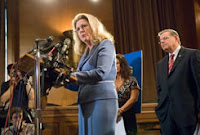
 By SUSAN DOWD STONE
Featured Blogger
We have spent the past weeks celebrating the historic passage of The Melanie Blocker Stokes MOTHERS Act initiatives in healthcare reform; but there is one more step of advocacy we need from everyone RIGHT NOW that will greatly benefit the work all of you do for mothers and families in your communities! The good news is that it will take only five minutes and involves two phone calls. But we need your help by next Tuesday, June 22nd.
While development/assignment of the initiatives for research and public awareness campaigns are already law and will be budgeted accordingly, the 3 million dollars for grants to fund responsive community programs from many sectors needs to pass through the appropriations committee.
There are many fantastic organizations and programs out there whose funding could mightily contribute to the sustainment and formation of national, replicable blueprints for programmatic response to postpartum depression issues. Perhaps you or your organization have ideas for programs you would like to implement.
U.S. Senator Robert Menendez and Congressman Bobby L. Rush, are asking you to encourage your state senators and Congressman to “sign” the letter below.
All you need to do is 1 – call your two state Senators and 2 – the Congressperson representing your district to indicate you would like them to “sign” this letter.
If you are calling your state senator, please refer to U.S. Senator Robert Menendez’s letter regarding funding for the Melanie Blocker Stokes MOTHERS Act; If calling your Congressman, please refer to Congressman Bobby L. Rush’s letter in support of funding for the Melanie Blocker Stokes MOTHERS Act.
To find the phone number for your state senator click here.
To find the U.S. Congressman/woman representing your district, click here.
Dear (Chair and Raking Members of Senate/House Appropriations Committee):
We are writing (calling) to express our strong support of funding for the Melanie Blocker Stokes MOTHERS Act, which was signed into law as part of the Patient Protection and Affordable Care Act (Section 2952 of P.L. 111-148). This provision has the support of over 20 national organizations, and we believe that it deserves priority consideration during the appropriations process.
This new law authorizes $3 million for a grant program to provide services to women with postpartum depression. Therefore, we respectfully urge you to provide initial funding of $3 million in FY 2011 to make this important program a reality.
The Melanie Blocker Stokes MOTHERS Act will help provide support services to women suffering from postpartum depression and psychosis and will also help educate mothers and their families about these conditions. In addition, it will support research into the causes, diagnoses and treatments for postpartum depression and psychosis.
As you know, postpartum depression is a devastating mood disorder which strikes many women during and after pregnancy. It is a serious and disabling condition that affects 10 to 20 percent of new mothers. In the United States, there may be as many as 800,000 new cases of postpartum conditions each year. These mothers often experience signs of agitation or depression and may lose interest in friends and family, feel overwhelming sadness or even have thoughts of harming the baby or themselves. Unfortunately, in the most extreme cases some mothers have acted on those thoughts.
The funding we are requesting would go toward the creation of a grant program for the establishment, operation, and coordination of effective and cost-efficient systems for the delivery of essential services to individuals with or at risk for postpartum conditions and their families.
Local community organizations, hospitals or even state or local governments would be able to apply for funding to provide education and services with respect to the diagnosis and treatment of postpartum depression. For instance, if the recipient is a medical facility, the grants could be used to educate new mothers and family members about postpartum depression before new mothers leave the health facility.
Thank you in advance for your consideration of this request. By providing $3 million in FY 2011, we will be able to begin implementing this important program in communities across the country. We look forward to working with you on this important program.
Sincerely,
(your name)
Thursday, June 17, 2010
Five more minutes to fund postpartum depression grants


Wednesday, May 26, 2010
The evolving illness
 For years, it was called the baby blues. The sadness and illnesses felt by women after giving birth was not even officially listed as an illness.
To this day, no one really knows what postpartum depression is all about.
Yes, advances have been made in the diagnosing of the illness. Yes, the symptoms of depression and psychosis are much more evident than they ever were.
But what can in trigger? The practice of diagnosing some mental illnesses is changing by the year. Schizophrenia, for example, is no longer thought of only something that's inherited.
Illnesses like schizophrenia, however, at least have had the backing of researchers and even some politicians. Now postpartum depression has taken that step with the passage of the MOTHERS act, which will help those diagnosed with the illness to achieve insurance parity.
It will also encourage further research into an illness that had long been ignored until several high profile public figures began to talk about it.
It will encourage people to study cases that are similar to what my mother experienced when she suffered from the symptoms of it in 1967 and 1968.
She refused to leave the house for days, and she went into panic attacks whenever she would attempt to do the normal routine chores of her life.
From there, her mental state evolved, and she developed the full-blown symptoms of obsessive compulsive disorder that ultimately led to her 2003 death.
To this day, we still don't know if there was a postpartum connection to the OCD. Maybe someday we will.
Tuesday, May 11, 2010
Mother's Day, uninterrupted
 Just after Mother's Day, we get another day to celebrate motherhood, the most underpaid job in the world.
Leaders in the fight against postpartum depression are now celebrating the passage of the The Melanie Blocker Stokes MOTHERS Act – a long-overdue move piece of health-care legislation that was on life-support just two years ago.
The law, sponsored by U.S. Sen. Robert Menendez, was signed into law as part of landmark health insurance reform that passed Congress in March.
The legislation will establish a comprehensive federal commitment to combating postpartum depression through new research, education initiatives and voluntarily support service programs.
Menendez joined actress Brooke Shields and former New Jersey First Lady Mary Jo Codey Monday to celebrate the groundbreaking legislation.
“Today we celebrate a victory for women everywhere – a gift for Mother’s Day for all new mothers who suffer the agony of postpartum depression," he said.
Postpartum depression is serious and disabling, and the support structure has been woefully insufficient," Menendez said.
"We will attack postpartum depression on multiple fronts – with education, support, and research – so that new moms can feel supported and safe rather than scared and alone. I applaud the incredible group of advocates and inspirational women who helped this become a reality – I am absolutely thrilled that this is the law of the land."
“There’s a lot of shame and there’s a lot of guilt associated with postpartum depression, it is so prevalent and yet nobody discusses it,” said Brooke Shields, actress and author of Down Came the Rain, a book on postpartum depression. “I am happy that mothers in America will now be able to benefit from support services that will not only serve as comfort for her and her family, it will help to create awareness and lead the way out of this potentially devastating condition.”
“Finally, women all over the county are going to have access to the kinds of support services and information that women in New Jersey have had for a number of years,” said Mary Jo Codey, former First Lady of New Jersey and leading advocate in the fight against postpartum depression. And we're going to get more research into these insidious illnesses. This is what I'd worked and hoped for over a long period of time. I almost can't believe it finally happened!"
Brooke Shields, Sen. Menendez herald arrival of new era in maternal mental health
By SUSAN DOWD STONE
Featured Blogger
The lovely and gracious Brooke Shields thrilled the participants at this press conference as she took the stage with U.S. Senator Robert Menendez and other NJ advocates to proclaim victory for America’s mothers yesterday morning.
To see pictures from yesterday’s event, click here.
Just back from a European tour, starring in a Broadway play and releasing a new movie, “Furry Vengeance” Ms. Shields took time from her packed schedule to demonstrate her commitment to the issue she has long championed – maternal mental health.
Standing among the participants of mothers and their babies, advocates and healthcare professionals, Ms. Shields declared the role closest to her heart would always be that of mother. She became emotional when thanking Senator Menendez and the group of advocates for this “best Mother’s Day gift ever”.
Senator Menendez, who has tirelessly worked to include this bill in the recently passed healthcare reform legislation, spoke about the many benefits this legislation will bring to maternal mental health including further research, public awareness campaigns and grants for programs supportive to new and pregnant women struggling with these disorders.
He recognized the efforts of Former N.J. First Lady Mary Jo Codey and her husband Governor Richard Codey in having initiated the nation’s first state based law requiring attention to these illnesses, screening and education of healthcare professionals. Mary Jo’s program “Speak Up When You’re Down”, has saved lives and brought awareness to New Jersey families and is now a template for other state based programs across the country. Senator Menendez speaking to Mary Jo stated, “Without your efforts, we would not be here today”.
Senator Menendez also noted the considerable contributions of author Sylvia Lasalandra, whose book “A Daughter’s Touch” has indeed touched so many hearts and lives with its riveting account of her experiences with postpartum depression and the message of hope and family support it conveys. Sylvia thanked her daughter Melina Lasalandra Frodella, who she stated lives in her heart and is her daily inspiration in continuing the fight to help mothers.
I was humbled that Senator Menendez thanked me, representing Postpartum Support International and The Healthy Mothers Healthy Babies Coalition for my “influencial and powerful voice in garnering support for the legislation.” Perinatal Pro hosted a national petition in support of the bill and will continue to expand it in support of the bill’s funding! My own inspiration, in addition to the advocates present at yesterday’s function, is my daughter Julia who has always supported her mother’s efforts, joining with us to end this public health crisis.
In my comments, I noted that not once over the last seven years of advocacy, had I ever been approached by a pharmaceutical company to subsidize my advocacy, pay me consulting fees to promote their products, introduce forced medication into this legislation or advertise on my website (which is free from all commercial endorsements).
Indeed the bill does NOT subsidize medication or encourage its usage. What it DOES do is promote more research, public awareness, education and services for pregnant and new mom’s struggling from these disorders. The minority who characterized the bill as a diabolical attempt to medicate America’s mothers, did not succeed in discouraging support with these misrepresentations, but instead stimulated the debate that further clarified the legislation’s true purpose and garnered more support from mothers, legislators and those from organizational and professional communities dedicated to helping them.
Each woman’s recovery plan will be as unique as her experience and if medication is needed to end the agony of her symptoms, she should be supported and encouraged, with her healthcare professional always weighing the risk/benefits. The life-saving benefits of medication for any illness is a decision made between client and clinician.
Nonetheless, the bill does NOT subsidize medication and instead looks to fund a wide spectrum of programs and services to fulfill its noble mission. Examples of existing programs which demonstrate alignment with the bill’s initiatives are:
CBS Cares public service announcements on postpartum depression. The first national network to address this need, CBS donated millions of dollars in primetime airspace to deliver these life saving messages.
Postpartum Support International’s FREE weekly Chat with the Expert Sessions
TEXT4BABY, a FREE program launched through Healthy Mothers, Healthy Babies which advantages text messaging by sending health reminders to pregnant and postpartum mothers.
MEDEDPPD.org’s - MediSpin’s educational programs, initially funded by NIMH which offered FREE CEU courses for healthcare professionals.
stressors.
Another highlight from yesterday’s event for me was Senator Menendez’s recognition of the contributions of Emma Palmer, women’s health legislative assistant. Emma has coordinated the efforts among all the bill’s supporters for years. We all relied on her feedback and direction when attempting to galvanize support or organize rallies during pivotal moments in the legislation’s progress. THANK YOU Emma!!
Express your support for the bill’s funding by sending an email to me at susanstonelcsw@aol.com indicating your name, any affiliation and state, and it will be added to the national petition which will be sent to the appropriations committee.
Monday, March 22, 2010
Health care for postpartum depression
By SUSAN DOWD STONE
Featured Blogger
The historic passage of Healthcare Reform also makes history for America’s mothers as language from The Melanie Blocker Stokes MOTHERS Act becomes LAW!!!
Finally, the plight of millions of American women, infants and families has been acknowledged and the tide forever turned! With this long sought federal mandate, states will find more support for PPD programs, researchers will find funding encouragement to continue their search for etiology and cure, and communities will harken to respond to this unmet need. Grants will be made available to fund a variety of entities and programs charged with caring for women suffering from postpartum depression.
There are no words to express our collective gratitude to the following individuals who began this march oh so long ago. Each step was filled with conviction, tears, controversy, guts, belief, outrage, setbacks and hope. And tonight, we can all begin to feel that at long last the doors and hearts of America are open to the maternal suffering that may no longer be silent and stigmatized.
To U.S. Senator Robert Menendez, you are an unwavering champion of the women and infants you represent. Against all odds, you never once set aside this initiative. You are not the Senator from New Jersey, you are the Senator of America’s mothers.
To NJ Senate President Richard Codey and the courageous Mary Jo - beloved by all for taking on the most difficult role of her life – with your example, your stigma busting campaign and your groundbreaking state legislation, you set the bar for our nation to follow. “Speak Up When You’re Down” she said. And women have not been silent since.
To Congressman Bobby L. Rush, who brought the House to its feet with near unanimous consensus and forceful leadership on this issue, your unfaltering crusade has led us to this moment. Without your work, your belief, our voices would still be murmurs of closeted shame. You are the change you sought, you live the life you lead others to believe in.
And to Carol Blocker, who has walked a million miles to share her story of incomprehensible heartache so that others might be spared excruciating loss, know that Melanie Blocker Stokes lives not only in the eyes of Somer Skyye, but in every program and community which will safeguard their mothers. We Thank God for Carol’s advocacy.
Each one of us is aligned with one or all of these heroes. Be it through motherhood, fatherhood, childhood, advocacy, organizational and individual support, a foundation born of tragedy, experience, research, blogging, writing, singing, creating, art, music, medicine, psychology, non profit leadership, endurance, courage, community action or voices in unison, you have all indeed made a life saving difference.
And for every mother and child lost to this illness…every square on Postpartum Support International’s Memory Quilt…. read each year by PSI’s Founder Jane Honikman…you are not forgotten and your life continues to infuse helping, caring spirit throughout the community of motherhood.
To every person who signed the petition, know that your signature was seen; that it carried weight. From Congressional offices to Qunnipiac pollsters, the petition was read and referenced again and again. You fearlessly listed your names, dared to make your stand known, and said, Enough is Enough. You have won. Thank you for your virtual presence, your letters, your phone calls, your support, your persistence.
Below is the language included in tonight’s Senate Bill which will now become law. Note that it does NOT mandate screening OR subsidize medication. The breadth and depth of the services encouraged and supported by its initiatives open the door to programs from concrete services to help new mothers, to education, public awareness and support, research and access to treatment.
When we began this journey, we did so with the acknowledgement that the experience of motherhood is apolitical, universal in its reach. Tonight, let that shared love and reverence reach above political differences and prevail in this celebration of life-saving victory for America’s mother, infants and families.
Monday, March 1, 2010
Reclaiming the anniversary: one father’s journey
 By LAUREN HALE
Featured blogger
On April 9, 2009, I posted a moving story from Joseph Raso over at the Postpartum Dads Project. Susan Stone had originally posted this at Empowher.com and I reposted with her permission. The piece stayed with me.
On Wednesday night, I received an email from Joseph. It included a link to a video montage of his daughter, Crystal, set to the Rascal Flatts song, “Why.” Crystal tragically shot herself shortly after giving birth to her second child, Max. No one knew she had been struggling. They simply thought Crystal was being Crystal and worrying just as she always did.
No one was let in to help her. Her world turned upside down, inside out, and the only way she saw out was to leave her family behind in the most tragic way possible. Joseph has worked courageously and tirelessly to share Crystal’s story with as many people as he can in order to raise awareness of Postpartum Mood Disorders. And for that, I commend him. It is difficult work to take such a dark event and turn it into something so showered with light nothing can touch it.
Today, February 27, 2010, marks the second anniversary of Crystal’s tragic passing. Please join me in respectfully remembering her life. Join me in praying for her family, her parents, her husband, her children – praying they will continue to find strength and that God will bless them each and every day. Join me in sharing her story to raise awareness of Postpartum Mood Disorders. Click on the candle picture to light a virtual candle which will burn for 48 hours in honor of Crystal and mothers everywhere who needlessly lose their lives to Postpartum Mood Disorders each day.
I charge you with a simple task today. If you know an expectant or new parent, male or female, make a point of asking how THEY are doing. Encourage honesty. Don’t judge. Listen with compassion. Educate yourself and expectant/new parents about Postpartum Mood Disorders. Feel up to more? Challenge your local L&D to educate new moms if they aren’t already doing so. Please don’t let any more mothers suffer so alone and so silently. It’s just not okay.
(Before you click on the video below, please know that it made me bawl like a total baby after having read Joseph’s piece. And I don’t cry or bawl. Often. If you are not emotionally stable right now, you may want to skip the video. There is nothing graphic in it at all. It’s just very very moving. Kudos to Joseph for putting together such an amazing montage.)
The following is what Joseph shared with me via email when he sent me the video:
“This Saturday (02/27/10) is the second anniversary of Crystal’s passing. Mary, I, and the whole family miss her so. Seeing her children, Hannah and Max, almost daily is double edged sword. On one hand, being a huge part of their lives brings such joy, but on the other hand, every time we see them we are reminded WHY we are such a big part… it is because Crystal is gone. I thought you might want to keep this video in your library. Someday you might want to forward it to someone who could be at risk of postpartum depression. This song “Why,” by Rascal Flatts, not only tells the story of how our actions can affect others, it is also so beautiful, anybody could enjoy it. When I first heard it, I was reminded of what we went through after Crystal died. God Bless You.”
If you, a loved one, or a friend are coping with the recent loss of a loved one to suicide, please read this from the American Foundation for Suicide Prevention.
If you are contemplating suicide, there IS hope. There are people who love you. People who care and want to help you heal. Need someone to talk to right now? Click here for a comprehensive list of resources in the US.
If you are struggling with a Postpartum Mood Disorder, contact Postpartum Support International’s warmline at 1.800.944.4PPD. (I may just be one of the people to return your call – I’m a volunteer for the warmline in addition to providing support in my home state of Georgia)
Bottom Line here? There is hope. There is help. And above all, you are absolutely NOT to blame. And above that? You WILL be well.
Please feel free to share any of the above information on your blogs or within your networks. In fact, I encourage you to do so. Below is a button for you to place on your blog in remembrance of Crystal. The only rule is that if you download it and post it, it must be linked to Joseph’s YouTube video.
Here is a list of blogs participating in today’s remembrance event. A big Thank You goes out to all of them for great posts! (If you posted and you’re not listed below, please let me know so I can add you to the list!)
* Postpartum Progress: A Father Remembers His Daughter
* Ivy’s Postpartum Blog: Never Assume that All is Blissful
* ICanGrowPeople: Remembering Crystal
* Psych Central Family Blog: Postpartum Depression is Painfully Real
* Stumbling Barefoot: Remembering Crystal
Thursday, January 7, 2010
Historic legislation good for people suffering from postpartum depression
By SUSAN DOWD STONE
Featured Blogger
Judging from the emails I’ve received recently, some clarification would be helpful in understanding who’s on first, who’s at bat and when we may finally see our home run for America’s mothers and infants.
First, you can start by listening to this audio post which explains the basic initiatives of The Melanie Blocker Stokes MOTHERS Act (i.e. MOTHERS Act) which do NOT include PPD screening or medication.
This new audio post includes interviews with Dr. Michael Petriella, OB/GYN from Hackensack University Medical Center; Celeste Andriot Wood, assistant commissioner of the N.J. Family Health Services, and myself, all of us hailing from New Jersey and having worked with PPD legislation as advocates, policy makers and health care practitioners.
This story originally aired on the nationally syndicated program Radio Health Journal in December 2009, and was produced by MediaTracks Communications.
The new Healthcare Reform legislation which just passed in the Senate, is called The Patient Protection and Affordable Care Act. It contains many healthcare initiatives and new policies focused on improving women’s health and ACCESS to healthcare.
The two bills it includes most directly related to postpartum depression are:
The MOTHERS Act (you can read the bill here) which calls for PPD public awareness campaigns, education, research and funding of PPD services sponsored by U.S. Senator Robert Menendez, and The Mikulski Amendment (you can read a summary of this bill here) the very FIRST amendment proposed, passed and included in this bill which calls for screening for postpartum depression (among other women’s medical conditions including cancer screenings). This bill is sponsored by Sen. Barbara Mikulski.
These initiatives are separate bills both of which the Senate approved for inclusion in the Patient Protection and Affordable Care Actm which passed in the Senate on Dec. 24.
But neither of these initiatives would be receiving the public awareness and legislative support were it not for early efforts in the House and Senate to promote postpartum depression research and education. Congressman Bobby Rush has long been a champion of PPD research and education since moved by the plight of his constituent Melanie Blocker Stokes.
Melanie, a beautiful, intelligent mother of a young child with every reason to live, leapt to her death as a result of untreated postpartum illness. Her mother Carol Blocker has waged a tireless campaign to end ignorance. These early champions including Richard and Mary Jo Codey, who dared to look such darkness in the face helped create the initial public platform that led to laws in Illinois and New Jersey demanding more attention to postpartum mental health issues.
Regardless of your political leanings, this bill contains historic emphasis on women’s health care issues. And for those of us who are devoted to ending the stigma and lack of response to the public mental health crisis of PPD, our moment has come. Finally, the science, the studies, the stories and the unimpeachable truth of the devastating and deadly effects of untreated maternal depression are no longer to be ignored to the detriment of millions.
The next step in the legislative process for these initiatives to become law, is for the House and Senate to reconcile the two versions of the bill and send the final version back to both houses for victorious and final passage.
There is every reason to be encouraged that our PPD intiatives will remain intact during these negotiations as the House has previously passed – by nearly unanimous consent – The Melanie Blocker Stokes MOTHERS Act thanks to the decades long efforts of its House leader, Congressman Bobby Rush.
When will this happen? The passage of these initiatives are dependent on the passage of the entire healthcare reform package. It is expected that the intense legislative focus on healthcare reform could result in final outcome by early spring.
Susan asks that anyone wishing to sign a petition supporting the health care bill may sign here.
Monday, June 22, 2009
Mood music
 When it comes to mental health, Amy Sky believes in using metaphors to spread messages of hope.
For more than a decade, the Canadian singer-songwriter has used her craft to convey her struggles with postpartum psychosis and depression.
Sky, who has scored hits such as “Don’t Leave Me Alone” and “If My Heart Had Wings” has earned praise from an audience that yearns for support in a peaceful, kind, and respectful way.
“I was told that depression is the cancer of the soul,” said Sky, 47, who has two children. “I was treated well, however. But a lot of women are told to soldier on.”
Sky, who has placed four singles at the top of the Canadian charts, first experienced postpartum psychosis when her daughter was born 16 years ago. When her son was born, she thought she wouldn’t experience it again.
But she did—only this time, she was more prepared to deal with the worst of the symptoms.
“It can strike anybody at any time,” she said. “You can have horrible afternoons where you’re imagining things and hallucinating things. Then the next day you wake up and say, ‘I don’t feel so bad.’ There are mood swings.”
Since disclosing her personal struggles in 2004, Sky has spoken at charity fundraisers and made other appearances to spread awareness—an experience that initially was not easy. “When I first talked about it, I felt like, ‘Oh my God.’ I felt naked.”
Songwriting has been her most effective tool for reaching out. For her efforts, she receives fan letters and critical praise. “It’s therapeutic,” Sky said. “People are grateful. Now I realize there are things that I have to do.”
(This article was first published in Esperanza magazine in its spring 2009 issue)
Tuesday, June 9, 2009
In the spotlight
 Postpartum depression nearly killed Mary Jo Codey. Nearly two decades later, however, she doesn’t feel like someone who’s out of the woods.
Rather, the former first lady of New Jersey considers herself “lucky.” She’s lucky to have two grown, healthy sons. She’s lucky to have a house with a loving family.
She’s lucky to be alive. And she’s lucky to have a husband, Richard J. Codey, now the New Jersey Senate president, who’s one of the country’s most celebrated political advocates for mental health causes.
“I could have been in one of those hospitals,” said Codey. “He had empathy for it. I lucked out. He could have dumped me. He happened to love me.”
Codey, 53, has followed her husband’s lead and inserted herself into the role of advocate. She appears before groups to speak about how she managed to survive a lifetime of depression and a double mastectomy after breast cancer was discovered in 2002.
Codey also helped inspire her husband, when he served as acting governor from 2004 to 2006, to recommend spending $200 million for affordable housing for those with mental illness, among other pledges.
“It was a pact I made with God,” Codey said. “I didn’t want it to happen to other women.”
Codey’s struggles made national headlines three years ago, after two New Jersey disc jockeys mocked her history of battling postpartum depression, taking medication, and undergoing shock therapy. Rather than shy away from the publicity, she used it as a springboard to inspire others. She remembers suffering from postpartum depression and not being able find a book that could help her.
“I found myself in such a hole,” Codey said. “I just promised that I would never allow others to go through the same thing.”
(This article was first published in Esperanza magazine in its spring 2009 issue)
Wednesday, June 3, 2009
Blogger on a mission
 Others turn to medication or therapy to help them through postpartum depression or related disorders. Katherine Stone turned to the keyboard.
Four years ago, Stone started blogging about postpartum issues. Each time she wrote, she considered it another exercise in self-help.
That exercise, as it turns out, catapulted her into an advocacy career: her blog, Postpartum Progress, generates nearly 3,000 hits a week.
“Nothing in my background had anything to do with women’s health or mental health, so I certainly wasn’t prepared for how my life and perspective would change once I went through postpartum OCD,” she said. “The only thing that contributed to my interest in the subject was having gone through it myself.”
Stone, 39, who lives in the Atlanta area with her husband and two young children, said she first experienced postpartum obsessive-compulsive disorder—a mood disorder in which a woman tends to focus her obsessive thoughts on her baby—in 2001. “I had no idea what was wrong with me and was completely devastated.
“It was the worst thing that had ever happened to me. I felt alone, ashamed, and confused. Once I recovered I felt like it was incumbent upon me to help other women by making sure they knew they weren’t alone and that they shouldn’t be ashamed.”
Stone said it’s important for those who’ve experienced a postpartum mood disorder to speak up “so that women will feel it’s OK to reach out.”
“I wrote an essay about my experience with postpartum OCD that ended up appearing in Newsweek in June 2004. The responses that I saw about my essay a couple of weeks later in Newsweek’s letters to the editor section inspired me to do more.”
(This article was first published in Esperanza magazine in its spring 2009 issue)
Monday, May 11, 2009
Keeping postpartum depression in the public eye
 Sen. Robert Menendez, D-NJ, former New Jersey First Lady Mary Jo Codey, other advocates and health professionals are joining forces to push for the passage of Menendez’s legislation that would increase the federal commitment to combating postpartum depression.
The MOTHERS Act has wide support in Congress, but has been blocked primarily because of the opposition of a singular senator, Sen. Tom Coburn, R-OK. Codey has been public about her battle with postpartum depress and in support of the legislation.
Menendez said Mother’s Day "was not only a day to celebrate our mothers, but also to reflect on the burdens and challenges many of them face because of their enormous responsibility."
"Millions of mothers know all too well that postpartum depression is not only a real and debilitating condition, but that the education and support system is lacking. A federal commitment to educating and supporting new and expectant mothers can go a long way toward protecting women’s health and maintaining strong families.”
Postpartum depression is a serious and disabling condition affecting hundreds of thousands of new mothers each year. The new legislation would increase federal efforts to combat postpartum depression by:
- Encouraging the Department of Health and Human Services to coordinate and continue research to expand the understanding of the causes of, and find treatments for, postpartum conditions;
- Encouraging a National Public Awareness Campaign, to be administered by HHS, to increase awareness and knowledge of postpartum depression and psychosis;
- Requiring the Secretary of HHS to conduct a study on the benefits of screening for postpartum depression and postpartum psychosis;
- Creating a grant program to public or nonprofit private entities to deliver or enhance outpatient, inpatient and home-based health and support services, including case management and comprehensive treatment services for individuals with or at risk for postpartum conditions.
Activities may also include providing education about postpartum conditions to new mothers and their families, including symptoms, methods of coping with the illness, and treatment resources, in order to promote earlier diagnosis and treatment.
It is estimated that postpartum depression (PPD) affects from 10 to 20 percent of new mothers. In the United States, there may be as many as 800,000 new cases of postpartum conditions each year. The cause of PPD isn’t known but changes in hormone levels, a difficult pregnancy or birth, and a family history of depression are considered possible factors.
Sunday, May 10, 2009
A Mother's Day gift for those in need
By SUSAN DOWD STONE
Featured Blogger
Happy Mother’s Day for the lives you have nurtured and sustained that have immortalized your own existence, converging past, present and future in the face of your daughter or son. On this Mothers Day, I wish you joyful peace, as holders of the profound maternal wisdom that connects you to eternity.
While this is indeed my hope for all who read this letter, for some, the reality may be different. It may be that life after baby’s birth has not yet fulfilled your dreams, that the joy and totality of the complete maternal experience has eluded you. You may feel separate instead of bonded to your child, a panicked indifference to the experience and a deep sadness that robs your baby’s smile of its ability to move you.
If this is where you find yourself, please do not stand alone, but reach out to your loved ones and receive their willing support. Allow the universality of the birth experience to unite you with those who understand and lift you and your sweet babe safely to your path again.
I speak not only to mothers whose living babies are at the breast, but to those mothers who stand with empty arms whose eyes may be fixed on a distant horizon where too brief a life has wandered, a mother nonetheless. This mother may not find a kinship in her isolated mourning; we must reach out to her and lead her to her rightful place among us for babies seen and unseen never leave us.
I speak to mothers whose infants babble, whose infants cannot yet come home, whose children are grown, disabled or gone. I speak to my own mother and her mother before her and God’s entire kingdom of mothers be they two or four footed, yet swimming or flying among us. This purpose of procreation is a serious business it is the industry of life ever lasting yet we cast a smile as we carry these ancient secrets within us.
We are all of us, mothers of earth who claim this day as ours and say to all that we are the hope and the future that sustains and nurtures, who facilitate renewal; ours is a passage through heaven and hell for the sake of life. But in each instance we meet such challenge with joy, depth of purpose and fervor that makes us accessible and mysterious, formidable and gentle, raging and loving. I am thankful to stand among you, thankful to say to my mother and to hear from my child Happy Mother’s Day.
Thank you to those of you, who, through your organizations or individual requests, have added your name to support The Melanie Blocker Stokes MOTHERS Act. The best gift you can give present and future mothers on this day is to support the legislation that will help end the suffering of mothers and infants in the next year and your daughters and granddaughters to come.
If you have not yet done so please click on this link and join our efforts to end the misery endured by up to 800,000 women in America. The petition will be presented to U.S. Senate HELP committee members next week and currently represents over a million Americans who support this overdue bill. U.S. Senator Robert Menendez leads the senate sponsorship of this life-saving legislation and we are grateful for his determined advocacy.
If you’ve already sent an email to susanstonelcsw@aol.com with your name and state asking to be added to the constituent petition, please ask TWO MORE PEOPLE to join you!
In another fantastic step forward, Gerald F. Joseph Jr, MD from Louisiana, the 60th president of the The American College of Obstetricians and Gynecologists indicated that postpartum depression will be the major theme of his presidential initiative. Another wonderful gift to America’s mothers and healthcare providers. Read his entire statement here.
Thursday, April 2, 2009
The desperate village
By LAUREN HALE
Featured blogger
A sobbing woman walks into her obstetrician's office with a newborn baby. Sounds like the beginning of a bad joke, right? Well, for some unfortunate women, the joke is on them and it's a dangerous joke indeed. The women I am referring to are new mothers who have been courageous enough to seek treatment for a Postpartum Mood Disorder yet find themselves either denied assessment, dismissed, or inappropriately medicated and sent on their way with no additional therapy prescription, left wading fearfully and silently through dark waters.
In the spring of 2004, I found myself joining the ranks of women turned away by the very people they trusted the most – their physicians. For three months after the birth of my first daughter, I often struggled with sleep, snapped at my husband for no reason, yelled at the dogs for glancing my way , and constantly battled horrific fleeting thoughts filling my head. I finally garnered enough courage to call my doctor's office. I hesitantly admitted things weren't the way they were supposed to be. I was promised glow. Where was my glow? Where was this mythic calm? Where was my Vaseline lens of cheer, my soap opera happy mama moment? Why couldn't I enjoy my daughter instead of thinking she judged me every step of the way?
Armed with a 72-count questionnaire, answering yes to thoughts of harming myself or my infant, my doctor sat grinning across from me and told me I didn't have Postpartum Depression. What was his reasoning? At six weeks, a woman's hormones magically realign and all is right within the new mom psyche, according to him. (Never mind that Postpartum Mood Disorders can occur at anytime within the first year and most common onset is between two and four months, two weeks beyond his six week limit1) He then asked how important I considered breastfeeding my child, apparently ignoring my screaming infant in her car seat, the mini-elephant in the room. Medication refused, my diagnosis thrown out the window due to his belief in a very outdated time frame for onset and my apparent ability to dress myself and put on bare minimum make-up, I wanted to scream. He did offer an appointment with the in-house therapist. I never went. They kept calling to reschedule. Enough games waltzed through my own head on an hourly basis. I didn't need any of theirs added to the mix. I smiled and grinned my way out of the appointment and went home to weep.
When our daughter was five months old, we moved back to Georgia. I began to heal slowly. Or I thought I did. My depression never lifted and continued through my second pregnancy only to blow up a month after our second daughter came home after twenty-eight days in the NICU. I awoke that morning with one thought on my mind – how bad would it get if I let go? I didn't have the strength to hold on anymore. My tenacity flew the coop. Insecurity and Insanity soon took its place, landing me in a psychiatric ward before midnight. Never had I felt so alone, abandoned and scared.
My new doctor had prescribed one drug which worked until we increased the dosage. I believe this is what landed me in the hospital. Once there, my medication was changed. Slowly, I found myself able to function again. Smiles became more frequent, the fighting and accusations of deceit less so. I began to find other women to speak with about my journey, including Jane Honikman, the founder of Postpartum Support International. As I continued on my road, I founded a local peer support organization for moms and volunteered with Postpartum Support International. Not all new moms are as fortunate as I have been. This is why the Melanie Blocker Stokes MOTHER'S Act is an absolute necessity for American families.
Based on New Jersey's legislation spearheaded by New Jersey's former First Lady Mary Jo Codey. and including legislation put forth by Representative Bobby Rush, D-Ill., with tireless advocacy by Carole Blocker, mother of Melanie Blocker Stokes, the MOTHER'S Act or Melanie Blocker-Stokes MOTHER'S Act (H.R. 20) in the House and S 324 in the Senate, provides for essential research into the mental health of women resolving a pregnancy and encourages education of medical professionals as well as new and expecting parents. And contrary to belief passionately held by critics of the bill, the current version does not mandate screening of all new mothers. Instead a proposed two-year study of effective screening is to be completed by the Secretary of Health and Human Services. The MSB MOTHER'S Act also does not encourage increased medicating of America's mothers. Through it's provisions to encourage increased community support, development of community-based support programs, and education of medical professionals already working with this population. In my opinion, the increased education measures provisioned by the MSB MOTHER'S Act may reduce the amount of Mothers who are medicated or at the very least assure they are medicated properly, thereby avoiding unnecessary negative side-effects some people experience with anti-depressant usage.
Increased education including the public awareness campaign should also aid in removing the stigma and fear that has so long surrounded Postpartum Mood Disorders. This stigma has allowed Mothers to be ignored or mistreated when they admit their unexpected feelings of failure, guilty, and sometimes even insanity after giving birth for too long. In addition, many new alternative methods and correlations are being discovered and if funding were to be provided, more research into the alternative treatment field could be performed, encouraging doctors to allow more Mothers to use natural and holistic treatments to battle mild cases of Postpartum Mood Disorders instead of turning to the almighty anti-depressant, a treatment that is more often than not misused and misunderstood by general doctors. Up to 90 percent of new moms struggling with Postpartum Mood Disorders may be nutritionally deficient. For instance, some Mothers finding themselves struggling with a Postpartum Mood Disorder may find relief in supplementing with Magnesium or Calcium as deficiencies of both have been shown to manifest as depression or other mood disorder symptoms. Research has also shown Omega 3 to be effective in managing mood.
Mothers and children are the beating hearts of our future. We owe them all the support we can give them, especially now. With the net worth of families declining nine percent in the last quarter, more mothers are finding themselves having to join the workforce earlier than planned. Why is this significant? It's significant because working mothers are more likely to experience depression. A recent survey by Working Mother found that 91 percent of respondents had signs of depression. Take into consideration that one in five working women will experience depression in their lifetime, add a healthy dose of the Postpartum statistic of one in 10 new moms experience a Postpartum Mood Disorder, and you have quite a depressed population on your hands. Then add in a decrease in growth of the Psychiatric profession and you've almost got a pandemic on your hands inadequately handled by physicians not well-trained to handle the primary complaint. Would you trust your cancer care to a General Practitioner? No. You'd see an oncologist. Why should it be any different for a mental health illness?
According to an article in the St. Cloud Times, there is a five month wait to see a psychiatrist at a local clinic, even with the three staffed doctors seeing patients every twenty minutes. Angela Broska-Smith of St. Cloud did not receive the best support from her Primary Care Physician and ended up addicted to her medication. Why didn't she see a Psychiatrist? It's possible the five month wait played a major role in her decision. She hopes more primary care physicians are able to receive training in Depression & Anxiety conditions so others won't face a similar situation.
Carole Blocker, insatiable crusader, has led the charge in getting legislation introduced to prevent the tragedy of her daughter, Melanie Stokes, from happening again. Again, at the heart of the situation lies physician ignorance of Postpartum Mood Disorders. In her search for recovery, Melanie found herself hospitalized three times in seven weeks, given several different medications and still ended up jumping to her death from the 12th floor of a Chicago building. What if her physicians understood the disorders that occur so often to new mothers? Would Melanie still be here today?
So many studies have already been done regarding medical professionals and screening. One such study in 2005 by Seehusen, Baldwin, Runkle, and Clarke asked “Are Family Physicians Appropriately Screening for Postpartum Depression?” The respondents had some formal training in Postpartum Mood Disorders and recognized it as a real, serious, and treatable illness. Nearly one third of them always screened for PPD, with thirty percent of them using a validated screening tool. Only six percent of the respondents never screened. In contrast, a recent UK study revealed medical professionals worded questions to prevent a diagnosis or admission of Postpartum Mood Disorder from being given. The reason? No referral network and no knowledge of how to treat a woman with a PMD. It was not noted if the respondents in the UK study had received formal training regarding Postpartum Mood Disorders. Yet another recent study states that professionals in an academic setting feel comfortable and responsible for screening yet aren't charting their screens, counseling, or results. A precedence needs to be set to ensure all Mothers receive the same information and care during the postpartum period.
The MSB MOTHER'S Act will save lives. It will increase knowledge of Mood Disorders, enabling mothers and families to seek help sooner, encourage increased education of both medical professionals and parents alike. The world around the Mother has changed. She no longer has her extended family nearby to help with daily mothering tasks. No one to mentor her through pregnancy, labor, breastfeeding, spiraling moods after birth, diaper changes, diaper rashes, solid foods, sleep problems, ear infections, potty training, or handling more than one child. It truly does take a village to raise a Mother and the Mother's Act will help to create a solid village around America's Mothers, a village we all deserve and so desperately need.
Tuesday, March 31, 2009
Mothers can finally see the light
 The dark pall once cast over postpartum depression is becoming a bright light.
The U.S. House of Representatives voted overwhelmingly Monday to approve the Melanie Blocker Stokes MOTHERS Act, which will help provide support services to women suffering from postpartum depression and psychosis.
It also will also help educate mothers and their families about these conditions. If passed by the Senate and signed into law by President Obama, the legislation will support research into the causes, diagnoses and treatments for postpartum depression and psychosis.
Blocker-Stokes was a Chicago native and pharmaceutical sales manager who, after the birth of her daughter, developed a psychosis that ultimately caused her to jump from a 12-story window ledge to her death on June 11, 2001.
The bill, if enacted, would require the secretary of Health and Human Services to expand and intensify research activities regarding postpartum depression and psychosis. The bill would also require additional support for basic and clinical research, epidemiological studies, diagnostic techniques and educational programs.
Sunday, March 22, 2009
New life for postpartum depression legislation
By SUSAN DOWD STONE
Featured Blogger
Perinatal Pro is creating a state-by-state listing of ALL regional organizations, healthcare facilities, entities, blogs, websites, consortias and public and private agencies who wish to go on-record in support of critical postpartum legislation. If you would like to be added to the listing, please email me at susanstonelcsw@aol.com. It will be updated several times a week. Please note, this listing is public and will be sent to Congress the week of MOTHERS Day.
Here's the blog:
Great news from Randy Gibbs, Executive Director of Jenny’s Light, brother of Jennifer Gibbs and uncle of Graham Gibbs, that this amazing organization is endorsing the Melanie Blocker Stokes MOTHERS Act.
Based in Minnesota, Jenny’s Light is a not-for-profit organization created by the families of Jennifer and Graham Gibbs Bankston in response to their tragic, unnecessary deaths from postpartum illnesses. The mission of Jenny’s Light is to improve and save lives by increasing awareness of all perinatal mood disorders including postpartum depression.
As support for the legislation widens and deepens among our nation’s professional and non profit organizations, we would also like to hear from regional, public and private entities who wish to go on record in support of this legislation. Perinatal Pro intends to create a new state by state listing on this website of all organizations, blogs, consortia, websites and/or practices who want to proclaim their support for this legislation. We need to intensify our message to Congress that investment in America’s mothers and infants must remain a top priority, especially amidst challenging times which create additional stressors for our nation’s families.
2007 was a year of record births in this country at over 4.4 million. We need to be sure the systems are in place to support these mothers, infants and families, by raising awareness, educating providers and establishing accessible help networks in every community across America.
If you would like to see your organization listed here, please email me with the name and contact person in your organization.
Meanwhile, if you haven’t already, please sign the petition in support of The Melanie Blocker Stokes MOTHERS Act.
Also:
Representative Jessica Farrar has introduced a new bill to the Texas Legislature which would limit jail time for mothers who commit infanticide while suffering from postpartum psychosis. While enactment of this bill does not replace or affect the appropriate use of the insanity defense for such crimes – a defense which can eliminate jail time while mandating appropriate psychological treatment - it would limit jail time during the penalty phase of a trial for infanticide presented under manslaughter or murder charges. The option would apply to mothers deemed to have been under the influence of a pregnancy or lactation related mood disorder within 12 months of giving birth.
George Parnham, the Houston based attorney who defended Andrea Yates, helped draft the legislation and I was honored to serve as an advocacy consultant. You can read the story which broke in Sunday’s Dallas Morning News by Wendy Hundley.
There is one misquote in the article that is important to correct. Instead of “for every mother who receives treatment, there are ten who are in jail”, that statement should have read, “For every mother whose trial results in psychological treatment only, there are ten who may receive jail time under the current legal mandates”.
Providing this new option to jurors during the penalty phase following conviction would offer an opportunity to reduce jail time and increase likelihood of psychological treatment – a far more appropriate response. By its very existence this legal option would further decriminalize acts related to maternal mental illness, validate the suffering of these mothers and help turn the tide from ignorance to understanding and appropriate treatment.
While many other civilized countries in the world already have an infanticide defense that does NOT include jail time, the United States continues to lag behind in our legal and social understanding of these disorders. Efforts are underway on the state and federal level, such as The Melanie Blocker Stokes MOTHERS Act, to initiate public awareness campaigns, conduct more research and offer assessment, support and screening to mothers during and after pregnancy. The bill was reintroduced to the 111th Congress by U. S. Senator Robert Menendez in the senate and Congressman Bobby L. Rush in the House of Representatives this past January.
Postpartum psychosis is an extremely rare (less than 1 in a thousand) condition in which a mother may be susceptible to “command hallucinations”, i.e. auditory or visual hallucinations which may order her to kill her children in order to save them and her family or prevent evil. This condition presents a true psychological emergency and immediate treatment is required to prevent the possible advancement of the illness that could result in tragedy.
Because such psychotic hallucinations may continue for days at a time and result in the planning of death, it is difficult for a considering jury to believe the mother is truly insane feeling that “insane people are not logical and could not execute a step by step plan”. It is this misunderstanding of the course and content of psychotic illness which often brings such outrage and condemnation to the convicted mother during penalty phase of deliberating jurors, resulting in jail terms equivalent to that for intentional murder or manslaughter.
One method of determining psychosis is a mother’s own response to such troubling thoughts, feelings and urges. A woman with the more common postpartum depression, for example, may have thoughts of harming her baby or herself, or wishing to give the baby up for adoption, or wishing it had never been born, but she is deeply troubled and repulsed by these feelings and usually does not act on them. These mothers can find help and relief from intrusive or obsessional ideas through psychotherapy, medication, social support or all three together. On the other hand, a woman with the extremely rare form of postpartum psychosis believes these hallucinations are real, that the commands must be followed and is therefore more likely to act on such thoughts.
The proposed bill is not perfect. It would be preferable that psychological help and treatment be the only “penalty” for the mother who creates a crime while suffering from the severe incapacitation of a pregnancy related mental illness. But its submission to the Texas legislature marks a critical first step toward ending ignorance and acknowledging the reality, characteristics and attributions of postpartum mood disorders to nation of lawmakers and citizens who often have great difficulty accepting more realistic concepts of culpability in mentally ill mothers.
Many thanks to Representative Jessica Farrar and attorney George Parnham - both members of the President’s Advisory Council of Postpartum Support International, for continuing to champion legal process and precedents for women suffering from postpartum illnesses. It takes great strength of character and forceful commitment to weather storms of public outcry that may emerge as a nation searches its soul and moves toward empathic understanding of maternal mental illness.
Tuesday, February 3, 2009
Getting the public to pay attention to postpartum depression
 Postpartum depression is getting a public airing.
ABC television network's "Private Practice" series is supporting postpartum depression awareness efforts by showing an episode on Feb. 12 with a storyline on the topic.
ABC also consulted with Postpartum Support International to create a public service announcement about postpartum depression, which will be available on the network's website immediately following the show. Contact information for Postpartum Support International can be found.
While the episode has not been seen prior to airing, postpartum depression advocates are hopeful that the material will "closely correspond to the clinical presentations women experience when going through postpartum depression."
"Storylines which responsibly present the ravages of these illnesses without the alienating sensationalism - which fuels stigma rather than hope - can greatly influence a nation's response to those suffering from these illnesses."
Susan Dowd Stone of Postpartum Support International thanked ABC for its willingness to not only approach this critical subject matter, but to offer viewers contact information to Postpartum Support International, the world's largest nonprofit devoted to the eradication of perinatal mood disorders.
"This ensures that those moved by the shows content will not be left wondering where they can go to find help for themselves or a loved one," Stone said.
"This year, as we seek to finally pass The Melanie Blocker Stokes MOTHERS Act,we are grateful for the educational outreach offered by such leading networks in our fight to eradicate the needless suffering of the over 800,000 women who will experience a perinatal mood disorder this year," she said.
Tuesday, January 27, 2009
Postpartum depression treatment gets a second chance
By SUSAN DOWD STONE
Featured Blogger
U.S. Senator Robert Menendez, D-N.J., has reintroduced postpartum depression legislation in Senate.
Today, I had the joy of participating in a conference call with the office of Senator Menendez and the other organizational sponsors of The Melanie Blocker Stokes MOTHERS Act where we received the heads up that U.S. Senator Robert Menendez was hoping to reintroduce the bill today. And as of this afternoon, that is exactly what he has done!! For hundreds of thousands of American mothers and families, this renews the hope that 2009 will indeed be the year when Congress acknowledges our nation's mothers by addressing the full spectrum of maternal experience and finally passing this legislation.
The statistics we have on the numbers of women suffering from perinatal mood disorders (which range from 12 to 22 percent in the research) easily exceed the incidence associated with a public health crisis. And remember, these statistics, do NOT include the suffering of women who miscarry, endure stillbirths, give up babies for adoption or terminate pregnancies, all of whom are also susceptible to these devastating disorders and whose circumstances are included in the furthering of research and support being sought.
It is not too soon to begin contacting the senators in your state to let them know you support this long overdue legislation!! And while you are at it, feel free to express your support to U.S. Senator Robert Menendez for whose steadfast determination we are so very grateful.Thank you to Senator Robert Menendez and the bill's other leading cosponsors, Senators Richard Durbin, D-Ill., and Olympia Snowe, R-Me.
If your organization would like to become a sponsor of this crucial bill, please contact Emma Palmer in Senator Menendez's office at 202-224-4744.
Please visit again soon for the link to an online petition which will be available across the country.
The latest copy of the The Melanie Blocker Stokes MOTHERS Act, follows the official press release below!
COMBATING POSTPARTUM DEPRESSION: SEN. MENENDEZ BEGINS PUSH IN 111TH CONGRESS
MOTHERS Act reintroduced in Senate, was close to passage last year
WASHINGTON – U.S. Senator Robert Menendez, D-N.J. on Jan. 26 officially kicked off his efforts to secure an increased federal commitment to combating postpartum depression by reintroducing the Melanie Blocker Stokes MOTHERS Act in the Senate. The legislation, which is co-sponsored by Sens. Richard Durbin, D-Ill. and Olympia Snowe, R-Me., has support from Senate leadership. It was nearing passage last year, despite being blocked from a vote on the Senate floor by Senator Tom Coburn, R-Okla., who has objected to this and other bills targeting specific diseases on ideological grounds.
“We gained significant support for this effort to combat postpartum depression over the last two years, which makes me optimistic that we will be able to deliver this gift to new mothers,” said Senator Menendez. “Increasingly, my colleagues in the Senate are learning about the vicious, debilitating nature of postpartum depression and how it affects families, and they understand why this initiative is so important. We have to attack postpartum depression on all fronts – with education, support, and research – so that new moms can feel supported and safe rather than scared and alone.”
Postpartum depression is a serious and disabling condition affecting hundreds of thousands of new mothers each year. The new legislation would increase federal efforts to combat postpartum depression by:
* Encouraging Health and Human Services (HHS) to coordinate and continue research to expand the understanding of the causes of, and find treatments for, postpartum conditions.
* Encouraging a National Public Awareness Campaign, to be administered by HHS, to increase awareness and knowledge of postpartum depression and psychosis.
* Requiring the Secretary of HHS to conduct a study on the benefits of screening for postpartum depression and postpartum psychosis.
* Creating a grant program to public or nonprofit private entities to deliver or enhance outpatient, inpatient and home-based health and support services, including case management and comprehensive treatment services for individuals with or at risk for postpartum conditions. Activities may also include providing education about postpartum conditions to new mothers and their families, including symptoms, methods of coping with the illness, and treatment resources, in order to promote earlier diagnosis and treatment.
It is estimated that postpartum depression (PPD) affects from 10 to 20 percent of new mothers. In the United States, there may be as many as 800,000 new cases of postpartum conditions each year. The cause of PPD isn’t known but changes in hormone levels, a difficult pregnancy or birth, and a family history of depression are considered possible factors.
The Melanie Blocker Stokes MOTHERS Act, sponsored by Senator Menendez and Representative Rush, will help provide support services to women suffering from postpartum depression and psychosis and will also help educate mothers and their families about these conditions. In addition, it will support research into the causes, diagnoses and treatments for postpartum depression and psychosis.
Friday, July 4, 2008
The patriotic thing to do after Independence Day
 (In recognition of Independence Day, I'm reprinting a blog entry I wrote last year about postpartum depression legislation.)
Congress is just about ready to take a giant leap in the world of postpartum depression treatment.
Sen. Robert Menendez and Congressman Bobby L. Rush are finalizing postpartum-depression treatment and education legislation for its anticipated victory in the U.S. Congress.
The new name of the legislation will be "The Melanie Blocker Stokes Mom’s Opportunity to Access Help, Education, Research and Support for Postpartum Depression Act."
The lawmakers want to honor the substantial contributions each has made to this issue and continue to remember the woman - Melanie Blocker Stokes - who has become a symbol of the illness.
Blocker-Stokes was a Chicago native and pharmaceutical sales manager who, after the birth of her daughter, developed a psychosis that ultimately caused her to jump from a 12-story window ledge to her death on June 11, 2001.
The bill, if enacted, would require the secretary of Health and Human Services to expand and intensify research activities regarding postpartum depression and psychosis. The bill would also require additional support for basic and clinical research, epidemiological studies, diagnostic techniques and educational programs.
Tare still some Republicans who need some convincing.
"I assured our legislators that we will be ready to do whatever it takes - writing, blogging, calling, adding our voices, spirit and energy to help achieve this historic victory for America's mothers and children," said Susan Dowd Stone, president of Postpartum Support International.
"Julia," by the Beatles (A song that John Lennon dedicated to his mother)
Half of what I say is meaningless
But I say it just to reach you,
Julia Julia, Julia,
oceanchild, calls me
So I sing a song of love, Julia
Julia, seashell eyes,
windy smile, calls me
So I sing a song of love, Julia
Her hair of floating sky is shimmering, glimmering,
In the sun Julia, Julia,
morning moon, touch me
So I sing a song of love, Julia
When I cannot sing my heart
I can only speak my mind,
Julia Julia, sleeping sand,
silent cloud, touch me
So I sing a song of love, Julia
Hum hum hum...calls me
So I sing a song of love for Julia, Julia, Julia
Friday, April 18, 2008
Time to stop talking, and start doing something about postpartum depression
By SUSAN DOWD STONE
Featured Blogger
While we await positive action from our nation’s legislators on The Melanie Blocker Stokes MOTHERS Act, questions arise.
It’s true we now have two states out of 50 with legislation on the books strongly encouraging screening, education for consumers and healthcare providers and services for new mothers. Many other states are in the process of developing programs thanks to the tireless efforts of grassroots organizations and advocates who have decided that lives will not be lost on their watch by the devastation of untreated maternal depression.
We need a federal response because research and education .. not geography... should determine what services will be consistently available to all American mothers. And that is exactly the goal that The Melanie Blocker Stokes MOTHERS Act intends to initiate.
There is nothing in TMBSMA that suggests mandates for anything.. no conspiracy to medicate moms, take away children - its modest request for funding streamlines the focus of its initiatives - READ THE SUMMARY and see for yourself. This truly bipartisan effort is about research education and provision of services for long suffering moms who have not had such access in the past and disgracefully still don't. Currently only 15 percent of afflicted mothers will ever receive any treatment.
Treatment can take many forms including social support, consumer education, better nutrition and self care, therapy, and sometimes medication. No choice should ever be discouraged - each women's experience is as unique as her life, and her recovery plan should reflect all available options! To cast aspersions or imply weakness when medication is warranted for recovery is like telling a diabetic woman she should be ashamed of taking her insulin.
We routinely screen - without any public outcry - for many other pregnancy related conditions whose incidence is less than the up to 20 percent of mothers (that's 800,000 without counting women who miscarry or whose babies are stillborn) who may develop a serious mood disorder this year! There is a long list of other illnesses - including breast cancer - which appear less frequently among American women, but which generate appropriate and unquestioned societal, legislative and healthcare response. But we do not consistently and routinely ask the right questions of pregnant and postpartum women. The difference is the stigma of mental illness.
Research continues to point to early brain development in the neonate as exquisitely sensitive to its environment – an environment whose quality largely depends on the health and abilities of its mother. In no other illness is the fate and future health of one innocent so closely tied to the present health and abilities of another. So we can pretty much double the number of those directly affected by pregnancy related mood disorders without argument. The statistics of those afflicated will continue to rise in numbers completely disproportionate to our abysmal response.
Perhaps when further research on long term societal, family and psychological effects finally translates into economic loss, this destroyer of our motherhood's expected joy will finally receive the attention needed to end truly needless suffering. The irony is that here's one condition where PRIMARY PREVENTION, i.e. methods to reduce the incidence and effects...is entirely possible. By our avoidance and refusal to implement a national, prosocial and adequate response we pay many times over for such ignorance... and those who pay the most are our most vulnerable citizens.
One can only incredulously wonder why on earth there would be any objection to federal encouragement and support for the research, education and services needed to end the loss of lives and incalculable suffering. Federal support means everyone is on notice to get up to speed. Federal support means the services are available to the many, not just the few. And federal support and acknowledgement means the beginning of the end of stigma.
The reality of maternal mental illness is a fact which cannot be challenged. The battle could go on another ten years depending on our demands of our elected officials to end a public health crisis. But while constituents remain inert about taking action, while we split hairs over definitions, form camps about what treatment is best, allow our legislators to politicize the problem and take aim at each other instead of the issue, suffering is prolonged for those too ill to participate in the calls for help.
Bills are passed for new roads while mothers experience unfathomable despair. Bills are passed for bicycle helmets while the partners of such mothers initiate a desperate search for help. Bills are passed for mortgage relief and campaign finance reform while babies cry alone.

Women are the majority of voters and our children are held up as the future of our country yet we are often silent for ourselves and our children - unused to the direct solicitation of our opinion as one that deeply matters and which can shape future policy. We are often too quickly grateful for any consideration received instead of demanding what is truly needed.
Friday, February 8, 2008
Postpartum depression legislation is ready to move forward - finally
 Supporters of legislation that will promote postpartum depression treatment are about to get their reward - and it's a Valentine's Day gift.
The Melanie Blocker Stokes MOTHERS Act will be marked up in the Senate H.E.L.P. committee on Feb. 14, which also happens to be Valentine's Day.
If all goes well, it could be passed by the committee on that day, supporters say. From there, it would go to the Senate and then return to the House of Representatives for final passage.
"As it originally passed by nearly unanimous bipartisan support in the House, we expect it would do so again," said Susan Dowd Stone, president of Postpartum Support International. "This is very encouraging progress."