Others turn to medication or therapy to help them through postpartum depression or related disorders. Katherine Stone turned to the keyboard.
Four years ago, Stone started blogging about postpartum issues. Each time she wrote, she considered it another exercise in self-help.
That exercise, as it turns out, catapulted her into an advocacy career: her blog, Postpartum Progress, generates nearly 3,000 hits a week.
“Nothing in my background had anything to do with women’s health or mental health, so I certainly wasn’t prepared for how my life and perspective would change once I went through postpartum OCD,” she said. “The only thing that contributed to my interest in the subject was having gone through it myself.”
Stone, 39, who lives in the Atlanta area with her husband and two young children, said she first experienced postpartum obsessive-compulsive disorder—a mood disorder in which a woman tends to focus her obsessive thoughts on her baby—in 2001. “I had no idea what was wrong with me and was completely devastated.
“It was the worst thing that had ever happened to me. I felt alone, ashamed, and confused. Once I recovered I felt like it was incumbent upon me to help other women by making sure they knew they weren’t alone and that they shouldn’t be ashamed.”
Stone said it’s important for those who’ve experienced a postpartum mood disorder to speak up “so that women will feel it’s OK to reach out.”
“I wrote an essay about my experience with postpartum OCD that ended up appearing in Newsweek in June 2004. The responses that I saw about my essay a couple of weeks later in Newsweek’s letters to the editor section inspired me to do more.”
(This article was first published in Esperanza magazine in its spring 2009 issue)
Wednesday, June 3, 2009
Blogger on a mission


The Chicken Zoo, part 2: The job (a non-fiction novel)
 [This story is based on my experiences as a reporter for The Delaware State News from 1990-93. Some names and dates have been changed. This was part of my unpublished novel, "The Chicken Zoo," that I wrote five years ago.]
I headed back to Dover. I stared out ahead, as focused on the road as I could be. My hands were still shaking a bit, but I calmed down rather quickly. I rationalized to myself – I mean, they were kids, right? What’s the worst that could happen to me?
I shook myself out of my trance and found the cell phone sitting on the seat. I hate those things. The word has it that they give you cancer. I’m so neurotic about cancer that I wouldn’t hold it next to my face. I never make a call on them – I only let people call me. That way I reduce the chances of me getting brain cancer by 50 percent, right? Whatever. I knew I had to get a hold of my boss, Jenny Cunningham. I was waiting for the last possible moment to call her, hoping that she’d eventually call me first. She’s pretty neurotic, too – one of those anal-retentive types. If things aren’t super-organized, she goes into a full-scale, convulsive panic-attack. Yeah, I know. I had to call her. I hadn’t talked to her for hours, and knowing Jenny, she was probably sitting by her phone the whole time waiting for it to ring.
So I punched the numbers. Suddenly, there was a ring. Was I calling myself?
I pushed the “send” button, and heard a voice. “Hello? Hello!”
“Hello? Jenny?”
“Tom?” Jenny said. “I can barely hear you.”
“Yeah,” I said, “I think this phone is bad.”
“No, hun, I think it’s because you’re holding it too far from your face…please move it closer to your face.”
Sigh. Fine. I guess I can tolerate a few minutes of radiation beams, I thought.
“How’s this?” I asked.
“Much better,” she said. “How’s it going?”
“All right, I guess.”
“What did you find out,” she said.
“Well, somebody got killed.”
“I figured that,” Jenny said. “What about it.”
“I don’t know – the cops wouldn’t say much.”
“What about the neighbors.”
“Oh, man, they were wacky…”
“Careful there,” she said. “They’re our readership base..”
“Do they even know how to read?”
“Tom, please,” she said. “Enough of the bullshit…tell me what they said.”
“Well, I mean, this is really unbelievable,” I said. “They said it might be connected to this Jim Jones thing – ”
Jenny stopped me. “Christ, the Jim Jones thing!” she said. “All right, well, hurry up…I’m not at the office, by the way. I’m at the Heartbreak Hotel.”
“The Heartbreak Hotel?” I said. “Where’s that.”
“It’s in the downtown, right across from the jail, on Governors Avenue. You won’t miss it. Meet me there in about 15 minutes.”
“All right. But can you give me directions?”
“You’re a reporter,” she said. “You’re supposed to figure these things out.”
Click, went the phone. Thanks, lady. OK, so now my assignment is to find directions to a bar. When I got out of college, I dreamed of working fro The Associated Press, dodging bombs in Beirut and interviewing the victims. Nope. Instead I’m trying to find my way to a bar in Delaware.
Fuck it. I drove, because what else was I going to do? Maybe it wouldn’t be hard to find, I thought. This wasn’t like driving in New York City.
When I first drove down there, just days earlier, I was struck by how flat and empty this place is. I mean, yeah, Delaware is small. But so is Rhode Island, and in Rhode Island, there are things to do. When I headed down U.S., I saw occasional shopping centers and conveniences stores. But everything else was flat, flat, flat, stretching out to the horizon. There weren’t even any trees. Just what looked like farmland that wasn’t even being used. The most interesting thing I saw was a liquor store with a message sign outside that said: “Get your guns and beer here.” Underneath that, it said, “Better dead than red” (wasn’t the Cold War over?).
I kept seeing these signs that said “Dover, 20 miles,” and then “Dover, 10 miles.” I got all the way down to one mile, expecting to see skyscrapers or something. Shit, I was hoping I’d at least see a town. Finally it said “Welcome to Dover.” But all I saw was a strip of fast-food restaurants and cheap motels, and a 100,000-seat racetrack. The fast-food joints were lined up like the animals on Noah’s Ark (two McDonald’s, two Burger Kings, two Wendy’s, two Hardee’s). This is the state capital, I thought? I started to wonder whether the state capital itself was in a shopping mall, and maybe the governor’s office was a drive-thru.
Well, it wasn’t that bad. But it was bad enough, and small enough that I couldn’t get lost. So when I headed out of Driftwood Beach, and saw a collection of collection of buildings, some big trucks and a highway up ahead, I knew exactly where I was. I knew that was Dover, and all I needed to do was to be a little enterprising and ask somebody for directions.
I got on Route 13, drove into a supermarket parking lot and saw and old guy pushing a shopping cart out of the store. Man, he was so old that he looked he should have been in the cart, being pushed. He didn’t look too happy, either. But was so desperate that I tried him, anyway. I pulled right up to him, and rolled down my car window.
“Excuse me, sir,” I called out. “Can you help me?”
He slowed up and turned his head, slowly. It was bent over the cart, and he was trying to get his frail body to push this heavy cart between two parked cars.
“What the hell do you want?” he said.
“Sir?”
“What is it?”
“I’m sorry to bother you,” I said. “Can you help me find the Heartbreak Hotel?”
“What are you from, Wilmington?” he blurted out.
“Sir?”
“What is it that you want?” the man said. “Why are you here?”
“I’m looking for the Heartbreak Hotel.”
“God almighty, what is it, is everybody too cheap to buy a map nowadays?”
OK, so I was trying really hard not to get upset. I mean, really hard. He was just having a bad day. He did not represent the opinions of the state as a whole. I mean, I just had to be nice to this guy. Otherwise, I had to get out of the car, go inside the supermarket and ask one of those dopey cashiers.
“Sir,” I said, “I’m really sorry. I understand how you feel … would you like me to help you with your shopping cart?”
“No, no, no,” he said. “I’m just having a bad day. A lot of traffic out there…. The idiots who run this city built all these goddamn shopping centers and roads and now it takes a half-hour just to run down to Acme to get a bottle of milk…”
“I see…”
“It’s just looking a little too much Wilmington.”
“Wilmington, sir? Isn’t that north of here?”
“Yeah, it’s about an hour north,” he said. “That’s the state’s power base. Home of DuPont. I used to work for them, for 40 years of my life. Then those slimy bastards laid me off….”
“I’m sorry, sir.”
“The governor – he spends all his time up there. They call this the state capital. Yeah. Ha. Then why the hell doesn’t the governor come down here once in a while, and run the state? I think they just want to turn Delaware into one big Wilmington, and rename it.”
“Sir, I hate to interrupt,” I said. “Can you give me directions?”
“Oh, sorry,” the man said, then pointing toward a series of trees and small buildings set back from the highway. “You gotta make a right here, then make your fourth left.”
“Right.”
“Then head down that road – Governors Avenue it’s called – and look for the jail. It’s on your left.”
“How will I know it’s the jail?”
“Oh, you won’t miss the jail,” he said. “It’s in-between a sub-shop and a barber.”
“Uh-huh,” I said. “Well, thanks.”
“Uh, wait, one more thing,” the man said.
“What’s that?”
“Are you sure you’re not from Wilmington?”
“Yeah, I’m sure.”
“OK, just checking,” he said, “Her voice didn’t sound like you was from here…”
“Why is that important?”
The man didn’t answer. He pushed the car out from the narrow space between the cars, and continued his slow walk. Maybe he didn’t hear me.
I was through with that. I got what I wanted, I hoped. I followed Governors Avenue, right on down. Right through the town, the downtown. Hey, a town, I thought. I finally found the town. There were houses dating back a couple of centuries. They were well-preserved, as was the capital building. It was a stately, colonial structure. Like other capital buildings, it had a small dome, a clock tower and a statue up top. But it was certainly much smaller and less busy than, say, the same buildings in Trenton or Washington D.C. for that matter. It didn’t have the same “buzz” as those places either. There were no people walking outside. There were no streets protests or fairs, no Frisbee-players or softball games. There wasn’t even a hot-dog cart to feed people. There were just a few old buildings with cars parked next to them, quiet and peaceful except for the occasional cars that drove by and struggled to get a parking space. Just like a shopping mall.
A block south was the jail. The jail. Christ, he was right. Right in between the subshop and the barber shop. In fact, it was right in the middle of everything, right in the middle of the downtown. My God. Couldn’t they think of a better location than this? I was suddenly reminded of those scenes from Clint Eastwood westerns like “Hang ’em High,” and I could see local townsfolk in the 1880s being dragged here for their execution. Only now there was a bunch of black guys playing basketball behind barbed wire. One of them noticed me gawking at them after I pulled up and parked the car.
“What’s your problem?” the guy yelled.
“Nothing,” I replied.
He smiled. So did I. Then he stuck up his middle finger and started laughing. I frowned. He kept laughing and returned to his game.
Yeah, right. Nice place. Luckily, the Heartbreak Hotel was only a short walk across the street. One look at that place, however, and I kind of felt like I had to get over there in a hurry. The place looked like it was ready to fall to the ground. Or, at least part of it did. The back half had this look like it was sinking. Outside, the paint was chipping from top-to-bottom, and in some spots it looked like holes were rotting right through the wood. Nice. Great place for a business meeting, right?
I walked in and humored myself, figuring it couldn’t get any worse. Well, it did. I stumbled over a foot-deep dip in the entranceway. I could feel my knee buckle as I set my foot in it. I didn’t mean to do that, but I did.
“Ouch!” I yelped. “What the hell was that?”
A sixty-something man in the lobby stood nearby, and started laughing.
“Watch it there, clumsy!” the man said.
“What the hell is this?” I said.
“It’s old,” the man said.
“Yeah, I see that…”
The man smiled. “Where you from?”
“New Jersey.”
“Yeah, up near Wilmington…”
“Huh?”
He laughed. “You that new reporter for The State News?”
“Yeah,” I said. “How did you know?”
“Your date’s here.”
“Who?”
He laughed again, then stuck out his hand. I shook it. “I’m Guy,” he said, “I own this dump.”
Too bad for him, I thought. Here it was, lunch hour, and there was hardly anybody here.
“Where is everybody?” I asked.
He laughed again. He had this big, cheesy, smile. It was like one of those sick misery smiles, like an undertaker's grin, And he laughed like he was a Dover version of Nero with his violin.
“That’s Dover… I’m taking in $200 a day,” he said. “The way it’s going, I might be out of business by the end of the year.”
“I’m sorry to hear that.”
“Hey, what am I going to do?” he said. “Everybody’s feeling it. Then they put that big godammned Wal-Mart on Route 13. Now everybody’s suffering.”
“Oh yeah, I saw that – I think it was between the McDonald’s and the Hardee’s, right?”
“Hey, whatever,” he said. “I guess you’re looking for Jenny, right?”
“Yeah,” I said. “You know her well, huh?”
“Sure do,” he said. “In Dover, we know everybody.”
Behind him, and as if it was on cue, the woman’s bathroom door swung open. Jenny appeared.
“Hey!” she said, excitedly. “How’s it going? Follow me.”
I did. We went to the dinging area, if you want to call it that (three picnic tables and an old wooden stove that was never used). At least the floor was flat.
Jenny pointed out her table, and picked up her three empty beer bottles and put them on another table. She had her fourth in her hand.
“We may be here a while,” she said. “Go ahead and get something to eat. I’m going to the juke box.”
I walked over to the bar and faced the baretender, who was wiping his hands on a dirty rag. I ordered a hamburger and fries, and waited. I didn’t wait long. He left for not even a minute, and produced the plate with my platter. It looked like it had been waiting their for him – the grease that had dripped out of the burger had already hardened into a while crusty material. It was like he knew I was coming.
The bartender seemed so willing to get rid of it. He thrust it rather hurriedly into my hands. And when he did, the plate vibrated and dumped a fry on the counter. I reached out to put it back on his plate, but the bartender reached first, and snatched it back.
"Hey, I was going to eat that," I said.
"I wouldn't," he replied, smiling.
He smiled, and disappeared into the back room, again. I walked back to Jenny’s table, plopped it in front of me and didn’t touch a bite of it. Hell, no. But, yeah, I was too chicken to ask for my money back.
Jenny picked her songs and sat. She was fortysomething but, hey, she was quite a looker. Her breasts and but were big, and she wore a leather coat and pants. Her black dress was low-cut. My eyes were in those boobs and, oh yeah, she noticed. She didn’t do anything to discourage it, either. But there was something steely and oft-putting about her, though. Yeah, her wardrobe was inviting, but her lips were so tight, and her chin always had this kind of chiseled look. She was like stone, like a statue in an S&M club. I felt it was a little too much like falling in love with the high school teacher, personally. Only this one chugged beer and smoked like a fiend.
“I’m ready,” she declared as she sat, and sipped some more beer. “Let’s get down to business…”
“OK.”
“First, let me give you this,” she said.
It was a memo. Bosses love memo. I was here for what, three days, and this was only my first. Consider myself lucky. This one had a title: “We Pledge” it said at the top. OK, I thought. Whatever. Let’s read it and see what this is all about.
The Delaware State News is the downstate daily that pledges to be a source of accurate news and information for the central Delaware readership. We pledge to be trustworthy, loyal and faithful to our readers.
“What’s this for?” I asked.
Jenny drank some beer, and wiped her lips with the back of her hand. “Well, we felt it was important to have a motto, of sorts,” she said. “Sort of a all-for-one, one-for-all kind of philosophy…I think it also creates an aura of discipline and respect that reporters should have…”
She lost me here. I didn’t really care. How bad could a memo be? I really didn’t want to get into a philosophical argument with somebody who was chugging beer and showing six inches of cleavage.
Jenny finished her beer, and signaled Guy for another. Then she downed that one, too, leaving about a quarter of it..
“So, how was the murder?” she asked, wiping her lips again.
“The murder?” I said. “Right. Well, let me tell you. I couldn’t make this stuff up.”
“Well, I already heard about it,” Jenny said. “Look, out here, this kind of crazy shit happens all the time.”
Man, I felt. That was discouraging. I couldn’t quit this.
“Yeah,” I said. “But what about a fat guy with cigarette burns on his chest, lying in the sand? Does that happen all the time?”
“Well, once we had a guy who had a heart attack after somebody stuck a lighted cigarette in his eye.”
“Wow,” I said. “OK, well, that’s certainly hard to top…”
“…And the cops didn’t show up until the next day.”
“Christ,” I said. “What’s the deal with that, anyway?”
“I don’t know,” Jenny said. I seemed to strike a nerve with that statement, because her eyes seemed to drift off.
“Sometimes I wonder why I stick around here,” she said, drinking her beer and puffing on her smoke. “I mean, I have a brain. I could have been a lawyer, even a doctor. But, what am I doing? Sticking around here and writing about trailer trash.”
I’m such a nudge. I heard that and I wanted to play lawyer.
“I thought you didn’t like criticizing the readers?” I said. I just wanted to know when was it allowed, and when it wasn’t allowed.
“Yeah, well, I can do it because I went to high school with them.”
OK, I thought. That’s hard to dispute.
“Right,” I said, uneasily. “You grew up around here, right?”
“Oh yeah,” she said, drinking more. “In fact – you know what’s funny – I grew up in a trailer.”
“Really?” I said. “What was that like?”
“What do you mean what was that like?” she said. “What do I look like, a fucking alien?”
“Sorry, I didn’t mean anything,” I said. “I never knew anybody who lived in a trailer.”
“Hey, it’s all right,” she said. “I get it all the fucking time.”
“I could imagine.”
“In a way, I’m proud of it,” she said. “All my friends lived in them, too. But I’m the only one who’s an executive – if you can call an editor an executive. Everybody else, they’re working in Wal-Mart and shit like that….They get excited if they’re promoted to retail sales.”
“Yeah, I can see that,” I said.
“Times were hard,” she told me. “But I think I proved that if you work hard, and make the right connections, you can succeed. It all depends on you, and how you approach your career.”
She emptied her bottle, and ordered another.
“I don’t know. Maybe I’m just burned out,” she said, slugging back some more. She was getting more disoriented, it seemed. With each minute, she was getting clumsy with the way she was holding the bottle. When I first got there, she was cleaning bottles from the table. Now she was spilling drops of beer on her dress.
“I do this seven days a week, really,” she said, not missing a beat, even as she spilled a big dropped right between her boobs. I pretended to care about what she was talking about. But watching this little wet-T-shirt contest was too good.
She drank some more, and then spilled some more. This was a big drop, and she finally noticed.
She asked for some napkins, and woke me out of my trance. Damn.
“Could you hand me some napkins?” she said.
“Huh?”
“Some napkins… over there, on that table.”
“Uh, yeah, right.” I reached over, grabbed some and handed them to her.
“Um, well, do you ever think about getting out?” I asked.
Jenny sipped her beer. “Nah,” she said. “I mean, I don’t know, I’m not usually this negative. I get the whole community-service thing. I think that’s what we’re doing – or at least, that’s what I tell myself. If it weren’t for that, I wouldn’t do it.”
“Right.”
“But in southern Delaware we’re it,” she said. “And what’s important is not what you’re covering, because the people around here, you know, they’ll hear about it, whatever it is. They’ll talk to each other, the whole thing. But what’s important is not what you’re covering, but how you’re covering it.”
Jenny finished her beer. Now there was silence. No signaling for another. I was a little surprised. A half hour into this and I thought it was just part of her reflexes. Now it was just the two of us, sitting there, looking around the room but not looking at each other. She puffed on her cigarettes, and her eyes grew red and heavy.
“OK, here’s your assignment,” she said, slurring slightly.
“OK, what’s that.”
“Follow this up,” she said. “You’re job from here on in will be to write about this. Write it, crack it, break it open. We need a big splash.”
I was stunned. A high-profile murder case? Only the big boys do that. Or so I thought. That’s the way it is in the movies. I should have just taken the ball and run with it. But I’ve been accused of having a big mouth before. Besides, she seemed to be a little too dismissive of the thing. It was like she just had had it. It was like she was just ready to crawl into bed. Does she know what she’s getting into? Who the hell is Jim Jones, really?”
“Are you sure?”
“Yeah, I’m sure,” she said. “I want a fresh face on this. Besides, you’re getting $9 an hour, so you’re worth it.”
She then smiled and sucked down the rest, emptying yet another. She was done.
“Yeah, but I mean, this doesn’t seem like any ordinary murder,” I said. “I mean, I’ve heard of Jim Jones, a little bit.”
“Yeah, and you probably heard how he and his waste-product friends turned a colony of Dover Air Force Base employees into looney tunes….”
“Yeah, I did…”
“I mean, this guy, what’s his name? Cramner? He’s a Jones Boy. I’ve heard of him…”
“That’s right,” I said. “Small state, huh?.”
“It has nothing to do that,” she said. “Look, I was here when the whole thing happened. I know all about Jim Jones. Christ, it was the front page of every fucking paper when it happened.”
“Did you cover it?”
“No. I wanted to,” she said. “They gave it to somebody else … hey, fuck, whatever? I mean, everybody wanted to cover it. It was hot for a few days there – the whole town was talking about, treating it like some big carnival, especially when the planes came in and dumped the bodies off at the mortuary.”
Jenny reached under the seat, and pulled out a stack of papers from pocket book. They were copies of a Newsweek magazine article she made years back, she said. But she saved them all these years, she said, because she wanted to remind herself of everything of, for and about Jim Jones.
She pushed my untouched hamburger and fries to the side, and slipped the papers in front of me.
“Go ahead,” she said. “Read the first few graphs.”
So I did.
Alert! Alert! Alert! Everyone to the pavilion!" The Rev. Jim Jones was on the loudspeaker, summoning the members of his Peoples Temple to their last communion. Dutifully, they gathered round; some of them, without a doubt, knew what was in store. "Everyone has to die," said Jones. "If you love me as much as I love you, we must all die or be destroyed from the outside." Mothers grasped their children to their breasts. "What have they done?" one screamed. Jones ordered his medical team to bring out "the potion," a battered tub of strawberry Flavour-aide, laced with tranquilizers and cyanide. "Bring the babies first," he commanded.
At the fringes of the huge crowd, armed guards fingered guns and bows and arrows. Some families edged forward voluntarily. Others held their ground. The guards moved in, grabbing babies from recalcitrant mothers and holding them up to let "nurses" spray the poison down their throats with hypodermics. A man showed a gun into the ribs of Rauletter Paul, who was clutching her year-old son, Robert Jr. "You dumb bitch," he shouted. "You better do it or we're going to shoot your ass off." Tears streaming down her face, she shot the poison into the baby's mouth, and he immediately began to scream and go into convulsions.
Sick. My God. Little babies. Little tiny babies. Sick.
“I can’t read anymore,” I said.
Jenny leaned back, lit up a cigarette, took a big drag and blew the smoke up toward the ceiling.
“Now imagine a big C-130 flies into your backyard, and dumps this on you,” she said.
“Christ.”
“This is what we had,” she said. “I read that over and over again. That could have been me writing that … I had big dreams, you know. I always saw myself working for The New York Times, busting crime and the whole deal. You know, I was young at the time, and I saw that as a big-ticket thing.”
I was still a little stunned, you I just felt like yessing her do death. I wasn’t in the mood to deal with someone who was so self-absorbed.
“I see.” I said.
“But that’s the fucking breaks,” she said, blowing more smoke toward the ceiling “Nothing I can do about it now.”
“Right.”
“But I can certainly help you,” she said. “Maybe this will be like payback time, you know what mean?
“Payback time?”
“Nevermind that,” she said, dismissively. Jenny’s eyes were sagging, and her chiseled look seemed ready to crumble. She didn’t seem to be ready for analytical thought. I just played along.
“The first thing you should do is talk to people who knew this guy,” she said. “You know, people who worked at the base.”
“Who’s going to talk to me from there?”
“Nobody,” she said. “I’m saying that you’re going to have to talk to people who used to work there…past tense, right?”
“OK.” I pulled out my pad, which I had stuck in my back pocket earlier, and prepared to take notes.
“Well, I know a guy named Chad who should be able to help you.”
“Chad?” I asked. “Who’s that?”
“He was a guy who worked at the base…I don’t know much about him, personally. He owns a bar in Rehoboth Beach, just like my family did. He and I used to compete against each other, in a way. He used to work in the mortuary and, boy, he used to tell me some stories…”
“Rehoboth Beach?” I asked. “Where’s that?”
“Where’s Rehoboth Beach?” she said, incredulously. “C’mon I. You can do better than that.”
She took my pad, wrote his telephone number on a sheet, and tore it off.
“Here it is,” she said, handing it to me. “Give him a call. I’m sure he could point you in the right direction.”
“Thanks,” I said.
“Now, let’s get the fuck out of here.”
“Is that it?”
“That’s it for now,” she said. “Just give me the cell phone.”
I had shoved them in side pocket, and gave it to her. Jenny then pulled out her long chain of keys, and twirled them around her finger as she headed for the door. She stumbled as she walked through the big dip in the floor. The bartender reached out to help her, but she waved him off.
She kept stumbling all the way to her car. I quickly followed her, right up to when she got in her Lexus, and positioned herself behind the wheel.
“Are you sure you can do this?” I asked, talking through the shut window on her car door.
"Just get the fuck in your car, and shut the hell up!”
I sat, and said nothing. Her eyes were really red now, and her slurred speech was practically incomprehensible.
“Really,” I said. “I can just get my car later.”
She didn’t listen. Her windows were shut tight. Her world was in front of her. She turned the ignition, and slipped out of the parking space with easy precision. Once on the road, I watched her, and grew envious – if not impressed – as she hovered between the lines like a pro.
Thursday, May 28, 2009
Tommy can hear it
 I've always liked The Who, but not so much for the loud guitars, the wild drum rolls or the screams that used to rip holes in my stereo speakers.
It's the songs that tell stories that flow from one song to the next. It's like every part of your childhood, your teenage years, right up to parenting can be felt through the prose.
There's nothing easy about the lyrics. They're not cut perfectly like a Beatles song. Pete Townsend's words often sound like they're jammed together so the long references to England and its grungy streets and neighborhoods can fit in a simple verse.
But they're interesting, unique and a challenge that has me listen for more than catchy hooks or gimmicky sound effects every time I play it. It's one band that never bores me.
Like Dylan once said, to John Lennon: I listen to the words, man.
As a youth, I thought it was cool that The Who named an album after me. I started listening to Tommy before I listened to anything else. I heard lyrics like, "Tommy can you feel me? Can I help to cheer you?" and think they were spoken to me, and me only.
As a teenager, I thought Quadrophenia was written for me. The songs had the tone of rebellion I felt as my mother's illness swarmed us. We yearned for escape from the tension and the feelings of helplessness.
But the songs also had the same sense of lost innocence and the naivete of Tommy, reflecting a certain idealism that children touched by mental illness and self-medication rarely felt: "But I'm one/I am one/And I can see/That this is me/And I will be/You'll all see/I'm the one."
Now, as a parent, I see Tommy again. I saw first it 7 years ago, when I was watching a Tommy production at Metuchen, N.J. High School. It was the best version I've ever seen (granted, I never saw it on Broadway).
I watched my son, Tommy, mesmerized as he watched the whole play, never looking away.
When I think of it, I think of my boy, the one who is away for three days on a fifth-grade camping trip. My boy can hit balls a long way. He can take me down in a wrestling match. He gets straight As in everything, and he's already read more books than I'll ever read. He's way beyond the video-game skills I developed at the Point Pleasant Boardwalk, drawing twice as many points in Galaga every time we play.
He can also see things better than others. He can hear better, too, sometimes too well. When he was young, we had to put our hand over his ears if things got too loud.
My boy gets passionate about things that he shouldn't care about. He crumples into a ball when he hurts, and he hurts mostly when he hurts others, because he certainly doesn't mean it.
He cares about who's president, or who wins the World Series, or if there are people starving in Africa. He's generous with his affection, and shares his emotions and passions.
People say he's me.
I have a friend I see every once in a while who says to me, "How can you like Tommy better than Quadrophenia? Quadrophenia's way better."
Tommy doesn't speak to me, he told me.
I couldn't disagree more.
You Didn't Hear It (1921)
I've got a feeling twenty one
Is going to be a good year.
Especially if you and me
See it in together.
Father:
So you think 21 is going to be a good year.
It could be for me and her,
But you and her-no never!
I had no reason to be over optimistic,
But somehow when you smiled
I could brave bad weather
Mother:
What about the boy?
What about the boy?
What about the boy?
He saw it all!
Mother and Father:
You didn't hear it
You didn't see it.
You won't say nothing to no one
ever in your life.
You never heard it
Oh how absurd it
All seems without any proof.
You didn't hear it
You didn't see it
You never heard it not a word of it.
You won't say nothing to no one
Never tell a soul
What you know is the Truth.
Friday, May 22, 2009
Revival at the river
 Two years ago this month, I was driving to Trenton. I was going to the N.J. Department of Transportation to pick up some stuff for a story. My stomach was roiling. I could feel my headache through my left eye.
"What the hell am I doing?" I kept asking myself.
Here I was, 40 years old, with a daily schedule of teaching classes at Rutgers University, a full-time job at The Record, coaching my son's Little League team and - the big one - going to classes part-time at Columbia University.
Oh, yeah, and I am a father of three.
I was trying to make up for all those years of "plateauing," of working long hours at The Press of Atlantic City and The Delaware State News and never really accomplishing much. I felt like I was trying to make up for it all in just one day.
That day, I taught a class at Rutgers. I answered concerns about the Little League team via email. I had to uncover a potential scandal involving school bus safety. And, that night, I had to go class - the second session of my first class - at Columbia.
I got to the Trenton Thunder ballpark and pulled the car over. I stared at the Delaware River. "What the hell am I doing? What the hell am I doing" I kept asking myself, over and over.
I called my wife. She got me a doctor's appointment. I wouldn't go to class that night. But I would finally get help for this panicking, this recoiling I always did in the face of pressure. It was the kind of thing that prevented me from reaching my potential.
At first, I rejected the idea. I was my mother's child, and I rejected all forms of help that would help my brain as much as they would help my body. My mother's fear of medicine helped bring about her slow, but steady physical deterioration that led to her death, in 2003. I didn't want to head down that same path.
I got help, and I did my two years at Columbia. They were probably the best two years of life. I found clarity. I found things out about me that I never knew. I learned how to build websites from scratch. I learned how to shoot and cut video. I started a book on my family's history of mental illness as part of a bookwriting course, and I got honors for the class. I learned not only how to write a book, but READ a book.
But it wasn't medicine or doctors or teaching that really brought about the change. I think of that line from scripture that was quoted in an important scene in "The Shawshank Redemption." It was the line that guided me as I endured taking classes, teaching classes, parenting and everything else.
Salvation lies within.
The Chicken Zoo, part I: The murder (a non-fiction novel)
[This story is based on my experiences as a reporter for The Delaware State News from 1990-93. Some names and dates have been changed. This was part of my unpublished novel, "The Chicken Zoo," that I wrote five years ago.]
I was never a big fan of covering cop stories.
I know, I know. If you’re a reporter, you should love death and destruction, right? Isn’t that every reporter’s dream, to be crack some big murder case, stand in the middle of the room and shout, “Aha! After weeks of great investigation, I have determined the identity of the killer!” I always feel like I’m sort of a buzzard that preys on people when they’re at their most vulnerable. It’s like this O.J. mentality where everybody obsesses over who-killed-who-and-left-blood-where [I barely watched that whole Simpson thing when it unfolded on television]. Then throw some sex and drugs into the whole thing, and watch the ratings go up even more, and the advertisement dollars reach six-figures. And then some opportunistic editor or television producer wants you to go victim’s parents’ house and chronicle their gut-wrenching grief. If they say nothing, that’s bad. Try again. If they express their grief without emotion, that’s OK. But keep going. If they cry, bullseye!
Screw that. I’d much rather meet up with Earl Jones at the farm and talk to him all afternoon about how the drought turned his corn stalks into brittle sticks. Or how about mayor who skims $100,000 from the town treasury and uses it to build a new porch on his house? That excites me.
Yeah, I know. Zzzzzz. That shit happens all the time. Believe me, I know what America likes and dislikes. I’ve lived my whole life like a human car wreck, and I see how people react when I tell them about all the stupid, reckless things I’ve done. I see their eyes bulge. I see them laugh. Then they tell 40 friends and I look like a universal idiot. But, hey, that shit excites people. That shit gets the blood flowing.
But it doesn’t mean that I have to like it.
So you could imagine my frustration when I got my first newspaper job out of college, and one of my first assignments was to cover a murder. Ugh. I mean, c’mon guys, the first day? I was half-awake for this, too – I had just moved into my apartment the night before. I didn’t have a lot to pack, but it took a while anyway – all day Saturday and then half the day Sunday. I didn’t leave until 7 p.m. I was told it would take two-and-half hours to drive from the Jersey Shore to Dover, Del. It took me four, largely because my mattress flew off my roof and landed in a puddle on the New Jersey Turnpike. The problem? I didn’t tie it tight enough. What can I say? Old habits die hard.
Monday morning, I threw on a set of clothes – a shirt with holes wearing through the elbows, and a pair of polyester pants that was so snug around the thighs, I had a hard time zipping my zippers. Hey, it was cheap shit. I had no job, no money. There was a recession going on. Reagan left office and left Bush and the rest of us to hold the bag. Besides, I was moving to Dover, Del., the trailer-park capital of the world, so I was told. Was there any need for Ralph Lauren? What, to impress women? Shit. I hadn’t gotten a real date since my girlfriend dumped me almost two years before.
At that point, I had no use for them, anyway. The last one I had left on some junior-year-abroad thing when I was a senior at Rutgers. She told me a thousand times, “I love you! I love you!” And then the minute she got off the plane in Israel, she met an Israeli soldier and I was history. Yeah, she loved me all right. Me? I was laying in bed all day, sick as a dog. Every couple of hours or so, I’d bend over the toilet, stick two fingers down my throat and puke my guts up. What can I say? It made me feel better. But then I lost 50 pounds in a month, and friends started calling me “Karen Carpenter.” The peer pressure and the ensuing embarrassment worked. So I stopped.
So I had no one to dress for, really. Not even for myself. Those polyester pants were wrapped so tightly, I sweated right through them. But, fuck it. I wore them anyway. I didn’t even really car that I was practically drenched as I drove in to the parking lot around 9 a.m. that Monday, ready to work.
I docked my car just beneath a small platform that carried a big, 10-by-11 sign. “The Delaware State News” it said. The sign was really too big. It’s not like people couldn’t figure out what this place is. It certainly wasn’t Times Square. Nothing surrounded it, except for a cornfield. There was no place to get a cup of coffee, no place to pick up a newspaper or even a corn muffin. No downtown, no Greenwich Village. Nothing. Just a cornfield. All my dreams I had of becoming a big-time journalist, and this was what I got. Thanks, God.
Whatever. I didn’t have time to think about it. Besides, as I walked toward the front door, a small, dark-haired woman with an unlit cigarette dangling in her lips came running, waving a cell phone at me. It was Jenny Cunningham, the editor. She wasn’t ready to give me a moment to breathe.
“Stop right there!” Jenny yelled.
“What?”
“I need to cover something,” she said. “There was a murder in Driftwood Beach. Here – I wrote out some directions for you. And take this cell phone – it doesn’t work too well, but it’ll do.”
“Who was involved?” I asked.
“I don’t know. You’ll have to figure that out,” she said. “I heard it over the scanner – some big dude was shot on the beach…”
“Shouldn’t I call first?”
“No time for that – just go!”
I grabbed the directions – they were written on a tiny stick note – and the telephone, hopped in my car and zipped out. Jenny stood at the curb, lit her cigarette and watched me – watched me good – until I slipped out of sight.
The directions were fabulous, even if they were hard to read. Maybe they were fabulous because the roads weren’t too hard to navigate. These roads were very flat, and very straight. No twists, no turns, no trees. They just ran through old dried up farmland that seemed endless. There was a lot of water – a lot of it that seemed to be running off the irrigation lines that cut through the green landscape, forming puddles on the roads and digging potholes in the asphalt. Occasionally, my car would hit one – BAM! – and shocked the frame so much that it vibrated.
But I didn’t slow up – I was too afraid to. Jenny called me every five minutes, giving me more and more questions to ask the cops. I tried to write them down as I was driving, but that didn’t work. So I had to stop, and I wrote them out on two pieces of paper I ripped out of my notebook:
“Who killed him?”
“What was he wearing?”
“Does he know the mayor of Dover?”
“Does he know the governor?”
“What was his favorite newspaper?”
“Was he black?”
“Was he gay?”
“Did he have any scars?”
When I got there, a bunch of kids saw me, and heard my tires make a crunching noise as they rolled on the gravel streets. They ran toward my car and surrounded it as I parked. Then they looked up at me as I threw open the car door and stood among them, carrying a new reporter’s pad in one hand, and a ballpoint pen in the other.
“Yeah?” I said to them.
They paused, before one of them yelled out: “A dead body’s out there!”
He was about 9, but pretty small for his age. He wore a Dale Earnhardt T-shirt and a pair of red shorts that ran past his knees.
"Hey," I said. "What's your name?"
"Evan," the boy said. “What’s yours?”
“Tom Davis,” I said. “I’m from The Delaware State News.”
“Wanna go see the body?”
Before I could answer, I looked down at the boy’s red hands. There was blood – sort of a darkish red color, like it was a few hours old. It was already crusting underneath his nails.
"My God, what is that?" I asked.
Evan laughed, and held up his hands in my face. "Got it from Mr. Cramner out on the beach. He's laying out there, all stiff and shit."
Christ, I thought. Where the hell am I? And why were all these kids all over the place? Wasn’t anybody supervising these children?
“Wanna go?” Evan asked.
“Where’s your parents?”
“Aw fuck ‘em,” he said.
“What?”
“Mom’s cooking dinner,” he said. “Besides, if she knew we wanted to go out there, she wouldn’t let us.”
I looked around. It was true. There wasn’t an adult anywhere. Not even a cop. But wait, why would the cops dispatch the call and not be here? I couldn’t make sense of any of this. But maybe I shouldn’t have tried.
“So you’re all I’ve got?”
“Yip.”
“Christ,” I said, “what the fuck should I do?”
“You could follow us, and get to see it,” Evan said. “Or you could wait for the cop, who’ll make you wait.”
“That’s wise,” I said. So I did.
We went, deflecting tree branches as we cut through a wooded area. There were a few trailers there, with clotheslines attached to the trees. We ran through quickly, but ducked occasionally to avoid the shirts, towels and underwear that dangled from the lines. Some 30 feet away, there were dogs – so big, they looked like pit bulls on steroids – who barked at the slightest crinkle of leaves.
“It’s okay baby!” Evan called out to the dogs. “It’s okay, baby! I know, big, nasty, mean people here.” But they just kept barking, loudly.
We made it to a clearing, and immediately spotted the body. Cramner was lying on his back, passed out on a layer of rocks and seaweed, turning green – it would appear – as the day grew old. He was covered with chest hair, sand, and blood, and his sideburns were bushy and dirty. What looked like burn marks covered his legs, and his smell was strong.
Evan laughed. "He's one hairy load, ain't he?" he said, grinning.
We walked closer, and the smell got worse. He smelled like old, stale cheese. I was sickened by it, and I had to take a few steps back. Evan? He started laughing again.
Evan then quickly turned around, and ran back toward town, laughing the whole time.
“Hey wait,” I yelled. “I’m not done here.”
But the boy kept running, and I followed. We ran toward a trailer, where Evan pulled up a cinder block to the window, stood on it and yelled through the sound of dishes clanking that came from the inside.
A woman came out, coughing, and carrying a cigarette that she was getting ready to light. Evan introduced her. “Ma, this guy’s from the newspaper,” he said.
She grabbed my hand and shook it, while I studied her face. I couldn’t believe it, but she so fit the stereotype. Her eyes were far apart, and a buck-toothed grin stretched across her face. Her cough and her voice gurgled in her throat.
“Hi,” I said. “I’m from The Delaware State News, and I’d like to ask you about this murder.”
“What about it?” she said. “What do you need to know?”
I had a list of questions, and I looked down to read them. But I got distracted by somebody who was pulling on my shirt. It was Evan.
“Where’s the T.V. camera?” Evan asked.
“I’m not from T.V,” I said.
“But I got somethin’ to say,” Evan said.
“What’s that?” I said.
"I think we should stick him on a pole,” Evan said. “We can call it the Driftwood Beach flag!"
I didn’t write down what he said. I just looked at him, and he smiled again and broke into laughter.
“OK, I’m trying to talk to your mother here,” I demanded.
Evan was distracted again, turning his head toward the beach. His smile grew wider as he spotted his friends. They saw us and were running over.
“It’s OK,” said Evan’s mother. She apparently detected the worried look on my face. “They won’t hurt you.”
They all had tiny stains of blood – mixed in with large patches of sweat – on their shirts. They were laughing and having the time of their lives, so it would appear. They joined us and stood behind me, giggling.
“Hey,” I said. “I’m trying to do my job here!”
“Kids, back off, please,” Evan’s mom said. “I’m sorry, Mr. Reporter man. But you know kids.”
“Actually,” I said. “I don’t.”
“See this is a big day,” she said. “Looks like they got one of Jones’ Boys again.”
“Jones’ boys?”
“Yeah, some guys who used to work at Dover Air Force Base. See, they got this morgue over there. A lot of guys got messed up working over there.”
“Morgue?”
“Yeah, they got this big morgue where all the Vietnam guys went through. I don’t know why – the Air Force picked us for some reason.”
I wrote that down. Until that point, my notebook was completely blank.
“Christ, that must be a bit unsettling, don’t you think?” I told her. “I mean, how many people died in Vietnam? They probably had planes in and out of here every day.”
“Yeah, but the big thing happened in ’78,” she said.
“What happened in ’78?”
“That was the Jim Jones thing, you know what I’m saying?” she said. She paused to light up her cigarette.
“I remember that,” I said. “I was pretty young at the time.”
“Yeah, well, this freak named Jim Jones had a cult. They were down in Central America – you know, one of those spick countries,” she said, sucking on her cigarette. “They went down to arrest him, and he was like, ‘Hell, no, I won’t go.’ So he and everybody Kool Aid with poison in it and killed themselves.”
“Yeah,” I said. “That’s what I heard.”
“Yeah, well, that’s what somebody told me, too,” she said. “Then the Army brought 900 men, women and children through there. They were all just a bunch of blue bodies and toe tags. A lot of guys got messed up, working on that shit.”
“Who worked there?”
“Well, Cramner was one of ’em,” she said.
“That guy out there?” I asked. “The one laying out on the beach? He works there.”
“Yeah, but he worked there, see what I mean. Like he doesn’t do it any more.”
“You mean, like, past tense?”
“Yeah, that’s it,” the mother said. “He was like a bunch of guys – once they got done out there, they came running to the woods. Then they never come out or anything.”
“That’s pretty crazy,” I said.
“I’ll tell you what’s crazy,” she said, sucking more on her cigarette. “One guy got so fucked up, he shot himself in the head. And guess what?…He lived?”
“Wow.”
“Yeah,” she said. “That was the last time something exciting happened out here.”
Generally, she said, this was a quiet place, far away from shopping centers, post offices and gas stations. And she liked that.
“See that out there?” she said, pointing toward a faded skyline to the north.
“Is that Wilmington?”
It was Delaware’s largest city, she said, the home of DuPont and its refineries that fill the air with smoke. It’s the state’ big employer, and as she called, “it’s intellectually center.” “But it might as well be China,” she added.
“It doesn’t seem so far away,” I noted.
“Yeah, well it is,” she said. “Here, the people are either unemployed or they tried to make some living out of fishing along the Delaware Bay …We don’t shop at the Gap ’round here.”
“What about farming?” I said. “I saw a lot of that on the way here.”
“Yeah, but they’re pretty useless now,” she said. “The crops are brittle and the grass is yellow.”
She talked about the long nights by the bay, listening to the water wash up and the sounds of boats and barges that pass by, some 10 or 20 miles out. She talked of hearing a piercing hiss of the boats almost nightly – usually around midnight that wakes people from their sleep.
When rain falls here, it falls hard, she said, usually causing the bay to swallow the beach, and forcing water to wash out the roads.
"It’s just too bad you people only come out there when something bad happens,” she said, smoking the last of her cigarette. “We're real people. We got real problems.”
She pulled out another smoke, and lit it up, exhaling into the foggy air. Her neighbors, she said, dread the strong smell of dead fish and rotting clams that comes from the bay. They hate the mischief that goes on at night – “all that drug dealing that goes on at the beach,” she said – and how the people wake up sometimes and finding toilet paper strung up in the branches, and on the clotheslines. They’re miles from the nearest police station, she said. But they’ve grown accustomed to it.
“I want no help from anybody, really,” she said. “I’ve taught my own children. I don’t send them to no Dover schools.”
“That can’t be good,” I said. I jotting some of this shit down, but I was doing more listening than anything. “You should send them to school.”
“You know what I like best about Driftwood Beach?" she said, ignoring me.
I picked up my pen. “What’s that?” I asked.
"No black people."
Ugh, I thought. I grimaced. But, dammit, wouldn’t you know that she read my face again.
"Now let me tell you something,'' the woman said, noticing my disgust. "I'm from Kentucky, and in Kentucky, they's everywhere. I know they here, but here they stay out of the way.”
It went on and one like for what seemed like hours. (it was only a half-hour). Yeah. A half-hour into this job, and I was already hating it. There’s nothing worse than having to give loathsome people a soapbox. But this was my job. Let’s give mediocre people a platform, and make them stars. Give them their fucking 15 seconds of fame. Christ. Is this what my life had come to?
Whatever happened to all that talk about me going to The New York Times? That’s what people said. I believed it. Did I earn a fucking diploma for this? I heard this mental midget go on and on, and my mind drifted. I wanted to know – who would really flatline the CAT scan? Would it be the dead guy on the beach. Or would it be the blithering idiot was living and breathing just inches from my nose?
I saw a cop car roll up, and I couldn’t help but laugh to myself. I’ve been here a half of a fucking hour, and I don’t see a cop? Weren’t they the ones who called over the dispatch? Christ. Talk about a disconnect. Jenny hears the dispatch call at 9 a.m. (or so I was told later). She tells me about it 9:30 a.m. It’s 10 a.m. Where were you?
“That’s unbelievable,” I said.
“What’s that?” Evan’s mother said.
“This is the first time I’ve ever seen the police arrive at a crime scene after the reporters,” I said.
“Well,” she said. “Maybe that’s why they call this ‘Lower Slower Delaware.’ ”
Two police officers got out of their cars – both uniformed, wearing those big trooper hats – and walked up, flashing their badges. Now Evan and his friends think I’m boring. They ditch me, see them, run up and jumped up and down, and wave their hands in front of cops’ faces. They gloated about their discovery. “We caught a whale!” they yelled.
Evan spoke up first, saying that right after they found some “big fat guy” they rolled him around in the sand like “cookie dough.” I listen to this, and cringe. Not out of disgust. I pity this kid. Can’t he think of a better adjective? I gotta write this shit, and I’ve got people using food metaphors for dead bodies. Is that all we are when we die? We’re just puffy, fatty, butterly cookie dough?
But it got worse. They said they put out their cigarettes in his chest hair, and “turned his blubber into an ash tray.” Ugh. OK, I can’t pity them anymore, I thought. Now it’s just deep-down, deep-seeded disgust I’ve got. They are just utterly repulsive. They just defy any sense of dignity. I didn’t grow up like this. No. Fuck it, I think to myself. I’m not writing this down. I’m not writing about IT. If the editors don’t like it, they can screw themselves. I’m trying to write a story here. Not a script for “Geraldo.”
The police didn’t have my luxury. They had to listen. Dammit, when you’re an hour late, you’d better. They pulled out notepads and jotted down some notes. Then, without showing a crack of a smile, or even a flinch of the eyebrows, they asked where the body was.
Evan back the way we came. Shit. We have to do this all over again? “I’ll take you there,” he said. “Let’s go.”
The police went. So did his friends. I waited. Fuck this. Why should I have do that again? Yeah, I know. Great color. Cops go to beach, and find a decaying man on the street. Perfect photograph, too. Only the photographer wasn’t there yet, so it was just me and my notebook..
“C’mon, Mr. Reporter man, let’s go!” Evan shouted.
I’d better go, I thought. So I did. And here we go again. The clothesline. The trees. The dog barking. I caught up. And there it was, still in the clearing. The body.
I caught up to everybody. But by the time I did, the cops shut us down. “OK, we’re good from here,” the cops said. “Back off now.”
We went back to the trees, and watched. The cops studied the naked carcass and jotted more notes. They were quiet, virtually emotionless. But I could tell this was affecting them. They’d show one little twitch of their mouth, their eye, their eyebrow. That said it all.
One cop finally stopped writing. He shoved his notebook in his back pocket, twitched his mustache and grabbed Cramner by the neck. He pulled his body up into a sit-up position, and placed his hands on his lap. He was like a big, ugly, rotting doll. The other cop just continued jotting.
We watched for about 20 minutes when the State News photographer arrived. He pulled up on a motorcycle, wearing a leather jacket and a big bushy mustache. He didn’t wear a helmet or anything. He looked like he was ready for danger.
“What do we got?” the photographer said.
“Well, you know what happened, right?” I said.
“Yeah,” he said, looking over at the cops. “But what are they doing?”
“I guess it’s part of the investigation,” I said.
The photographer pulled out his camera from his bag and stuck his lens through the bushes. Evan and the kids saw this, and rose out of their perched positions. They stood in front of his lens, jumped up and down and stuck their middle fingers up to the lens.
“C’mon, take my picture!” Evan yelled. “Take my picture!”
“What the fuck is with these idiots?” the photographer said.
“I don’t know,” I said. “They’ve been harassing me ever since I got here. I’ve learned how to shut them out.”
“Yeah, well, that doesn’t work for me,” the photographer said. “Please do something about them.”
Yeah, this camera guy was pretty bossy. I hate photographers who throw their weight around. They show up at these assignments, and they pretend that they’re your editor. Why? Because you’re intruding on their work, their art. They treat this like they’re painting the fucking Mona Lisa, when all they’re really doing is fitting a bunch of rednecks into a small frame. I’ve learned, however, that the best way to deal with them is to give into them. Otherwise, they can make big trouble for you.
“No problem,” I said to his request (or order). So I hushed them up.
“Shhhh!” I said. “You want the cops to throw us out of here?”
“Good thinking, Mr. Reporter man!”
After all this commotion, however, the cops were already through, sticking their notepads in their pockets and heading back to their cars. One got on a walkie-talker and dispatched an ambulance. The others just started walking back toward their cars. I rushed up to them to get a comment.
“Excuse me sir…” I said.
“If you want any information on this, you’re going to have to call Wilmington,” a cop told me.
“Wilmington?” I said. “Why not right here, right now?”
But they kept walking. They remained expressionless, except for the occasional eyebrow twitch. I persisted.
“Look, if you don’t talk, I’m going to have to say in my story that the Delaware State Police had no comment,” I said.
One cop kept walking. The other stopped, and turned to look at me. His eyebrow twitch went into a full spasm. His mouth was in a frown, and his eyes were burning.
“Get the fuck away from me!” he said.
Now what? There are times when I hate this job. And then there are times when I REALLY hate this job. I was hours into this new one, and inside, I was already crying for mommy. At least in New Jersey, the cops have enough of a vocabulary to politely tell you to get lost. Only now I was really lost. I looked around, and saw nobody who could help me. God, I hate that empty feeling. You’re out there in some God-forsaken place where there are no friendly people. You know no one. You like no one. And they don’t like you. They wouldn’t give you a penny if you asked them for a quarter.
I did see the photographer, and felt some comfort in that. At least there was somebody. But he was very busy, doing his job. And he was trying to do it by taming these little freaks that swarmed us like gnats from the moment we got there. He was lining up Evan’s family for pictures as a way to illustrate the scene.
“OK, act natural,” the photographer said.
I, his mother and the others then burst into a chuckle. Then they just started laughing.
“OK, ha, ha,” the photographer said. “Now let’s be serious.”
But they were still laughing. I glanced at my watch and saw that we had been there for more than an hour. Too long, I thought. So I rushed them along.
"Think about the death, the tragedy," he said, desperate to draw a tear or even a droopy mouth. Actually, even a stoic expression would have been enough. But the more I talked, the more they laughed.
The photographer tried, too. He urged them to cooperate. His words were so desperate that he sounded like he was begging. “Please?” he said. Please? Christ, they thought that was hilarious.
"How about a relative?" I asked. "Any relatives die lately?” Grandmothers? Uncles? Anybody you're sad about? C'mon guys!"
The photographer finally gave up, and so did I . He snapped the picture. “I’ll just airbrush it out of there,” he said.
“Let’s get the hell out of here,” I said.
Freedom. Finally. I went to my car, ready to drive back. But, ah ah. Not so fast, I boy. The gnats followed me, followed my the 50 yards to my car. They followed me close, too, running right up to my heals and keeping up with my stride. They said nothing, too. All I heard were their footsteps as their feet hit the sandy soil.
I ignored them and got in the car. I was done with these freaks. I got what I needed. I was done. Get lost. But nooo. They waited as I turned the key and started the car. Then they smiled – each one of them, as if it was staged – and started giggling as they stared at me through my front windshield.
I stuck my head out the window, and yelled at them. “Get out of the way!”
They were carrying rocks in their hands. Where did they come from? I guess I should have paid better attention to them when they were pestering me. They moved so quick, though. How did I know that 8-year-old rednecks could multi-task?
"I'd think twice before you throw those," I said.
God, was I naïve. When was the last time a kid ever listened to a grown-up? Besides, if I was 8-years-old and holding a rock, I’d throw it, too. So I knew my threat would go nowhere. In fact, that logic compelled me to stick my head back inside the car, shut the window, hit the gas and go.
As I pulled away, the stones started to rain on the front and back windshields.
I then heard a voice. It was Evan. "What do you think of that, Mr. Reporter Man?" he yelled as he picked up some more rocks with his buddies, and pelted my car. Amazing, I thought. Here I was, ripping out of there and roaring the engine. How did I still hear him through the glass?
"Let's do a story about Mr. Reporter Man bleeding from the head. Maybe if we get 'em unconscious, then that would be a front-page story. Do you think so, Mr. Reporter Man? Can you interview me?"
Monday, May 11, 2009
Keeping postpartum depression in the public eye
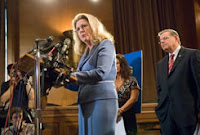
 Sen. Robert Menendez, D-NJ, former New Jersey First Lady Mary Jo Codey, other advocates and health professionals are joining forces to push for the passage of Menendez’s legislation that would increase the federal commitment to combating postpartum depression.
The MOTHERS Act has wide support in Congress, but has been blocked primarily because of the opposition of a singular senator, Sen. Tom Coburn, R-OK. Codey has been public about her battle with postpartum depress and in support of the legislation.
Menendez said Mother’s Day "was not only a day to celebrate our mothers, but also to reflect on the burdens and challenges many of them face because of their enormous responsibility."
"Millions of mothers know all too well that postpartum depression is not only a real and debilitating condition, but that the education and support system is lacking. A federal commitment to educating and supporting new and expectant mothers can go a long way toward protecting women’s health and maintaining strong families.”
Postpartum depression is a serious and disabling condition affecting hundreds of thousands of new mothers each year. The new legislation would increase federal efforts to combat postpartum depression by:
- Encouraging the Department of Health and Human Services to coordinate and continue research to expand the understanding of the causes of, and find treatments for, postpartum conditions;
- Encouraging a National Public Awareness Campaign, to be administered by HHS, to increase awareness and knowledge of postpartum depression and psychosis;
- Requiring the Secretary of HHS to conduct a study on the benefits of screening for postpartum depression and postpartum psychosis;
- Creating a grant program to public or nonprofit private entities to deliver or enhance outpatient, inpatient and home-based health and support services, including case management and comprehensive treatment services for individuals with or at risk for postpartum conditions.
Activities may also include providing education about postpartum conditions to new mothers and their families, including symptoms, methods of coping with the illness, and treatment resources, in order to promote earlier diagnosis and treatment.
It is estimated that postpartum depression (PPD) affects from 10 to 20 percent of new mothers. In the United States, there may be as many as 800,000 new cases of postpartum conditions each year. The cause of PPD isn’t known but changes in hormone levels, a difficult pregnancy or birth, and a family history of depression are considered possible factors.
Sunday, May 10, 2009
A Mother's Day gift for those in need
 By SUSAN DOWD STONE
Featured Blogger
Happy Mother’s Day for the lives you have nurtured and sustained that have immortalized your own existence, converging past, present and future in the face of your daughter or son. On this Mothers Day, I wish you joyful peace, as holders of the profound maternal wisdom that connects you to eternity.
While this is indeed my hope for all who read this letter, for some, the reality may be different. It may be that life after baby’s birth has not yet fulfilled your dreams, that the joy and totality of the complete maternal experience has eluded you. You may feel separate instead of bonded to your child, a panicked indifference to the experience and a deep sadness that robs your baby’s smile of its ability to move you.
If this is where you find yourself, please do not stand alone, but reach out to your loved ones and receive their willing support. Allow the universality of the birth experience to unite you with those who understand and lift you and your sweet babe safely to your path again.
I speak not only to mothers whose living babies are at the breast, but to those mothers who stand with empty arms whose eyes may be fixed on a distant horizon where too brief a life has wandered, a mother nonetheless. This mother may not find a kinship in her isolated mourning; we must reach out to her and lead her to her rightful place among us for babies seen and unseen never leave us.
I speak to mothers whose infants babble, whose infants cannot yet come home, whose children are grown, disabled or gone. I speak to my own mother and her mother before her and God’s entire kingdom of mothers be they two or four footed, yet swimming or flying among us. This purpose of procreation is a serious business it is the industry of life ever lasting yet we cast a smile as we carry these ancient secrets within us.
We are all of us, mothers of earth who claim this day as ours and say to all that we are the hope and the future that sustains and nurtures, who facilitate renewal; ours is a passage through heaven and hell for the sake of life. But in each instance we meet such challenge with joy, depth of purpose and fervor that makes us accessible and mysterious, formidable and gentle, raging and loving. I am thankful to stand among you, thankful to say to my mother and to hear from my child Happy Mother’s Day.
Thank you to those of you, who, through your organizations or individual requests, have added your name to support The Melanie Blocker Stokes MOTHERS Act. The best gift you can give present and future mothers on this day is to support the legislation that will help end the suffering of mothers and infants in the next year and your daughters and granddaughters to come.
If you have not yet done so please click on this link and join our efforts to end the misery endured by up to 800,000 women in America. The petition will be presented to U.S. Senate HELP committee members next week and currently represents over a million Americans who support this overdue bill. U.S. Senator Robert Menendez leads the senate sponsorship of this life-saving legislation and we are grateful for his determined advocacy.
If you’ve already sent an email to susanstonelcsw@aol.com with your name and state asking to be added to the constituent petition, please ask TWO MORE PEOPLE to join you!
In another fantastic step forward, Gerald F. Joseph Jr, MD from Louisiana, the 60th president of the The American College of Obstetricians and Gynecologists indicated that postpartum depression will be the major theme of his presidential initiative. Another wonderful gift to America’s mothers and healthcare providers. Read his entire statement here.