Those who cannot learn from history are doomed to repeat it. Those who do not remember their past are condemned to repeat their mistakes.
- George Santayana
I keep seeing all these postings on Facebook saying, "It's WAYBACK WEEK!!! RETRO RETRO RETRO!
Usually, I try to play the role of non-conformist and not give into tradition. But I've already ventured into this territory, so it's too late for me to be "cool:" This week, my Facebook page has become the video theater of the wayback (or just the wack).
My good brother has downloaded a series of videotapes that show every one of my television appearances. I' ve edited them and posted all of them. I've posted ones that have drawn a lot of attention (my appearance on an ESPN game show in 1988) while others probably should have remained on VHS (my panel appearance in a 1999 Easton, Pa. School Board debate - the only exciting moment came when I winked at the camera).
Each time I've done so, I've felt a mixture of excitement and guilt. In my mind, I still see myself as the same 20-year-old with brown hair. Now, when I see myself in a 22-year-old video, I see only contradiction.
I have to reconcile the young man with the middle-aged version. I have to reconcile the look of a full head of brown hair that's on youtube screen versus the man with the gray hair in the mirror. I have to realize that when I exercise and run five miles, I feel pains in places I never thought I'd feel.
I see myself on the ESPN game show, Boardwalk and Baseball's Super Bowl of Sports Trivia, in 1988, and I see how I felt like I could do no better. I was a top editor on a top newspaper at a top school, on a television network that draws some of the highest ratings on cable.
Looking at these tapes, I get that sense of wanting to be back there, in Orlando, hanging out with college kids who had money to burn. The things we did were the stuff of legend. Alumni of this event have even written about it: http://espn.go.com/page2/s/murphy/040202.html.
You'd think that I'd look at this history, and want to break out and sing "Glory Days" while drinking a six-pack of beer.
But I also look at the tape, and feel glad to be here, too, in 2010, with a family and a job and a sense of direction. I now have 22 more years of life on my side, and I've built up a stockpile of life experience that has made me stronger, savvier and more secure.
I no longer have money to burn, but I don't live like I did in the late 1980s and early 1990s, with a sense of living day-t0-day, worried that I'd never find a job once I got out of school.
Once I got out of school, I faded into near obscurity. I got a job, but I had little respect. I used to say that I was "writing to the wind," working for newspapers that don't even exist anymore. I used to worry until I got myself sick because, to coin Springsteen again, I had "debts no honest man can pay."
I look at another tape, made in 1989, a year after ESPN, when I was working for a weekly newspaper in central New Jersey, serving on a debate panel local election candidates. I went from ESPN to a newspaper that nobody read, on a cable channel nobody watched.
That's how things were for a while, until I moved onto The Press of Atlantic City, The Morning Call of Allentown, Pa. and then, finally, The Record, where one of my first assignments was 9-11.
I think back to what I've done over the past nine years and I realize that ESPN was fun, but it wasn't important. I think about what I've done at The Record, and also at The Star-Ledger, as part of a sharing agreement. I think about how I've flown with troops who fought in Afghanistan; how I've interviewed people who have lost loved ones in war and terror.
I think back to that and I realize: Nostalgia is a fun diversion. But maybe the glory days are now, and in the future. Even in these tough economic times, that's what I keep pushing for.
About 20 years ago, I complained to a friend that I wasn't getting anywhere in my life. The main thing, I said, was that I couldn't get respect. "Don't worry," he said. "When we get to our late 30s and early 40s, things will change."
Wednesday, January 13, 2010
The past is alive but barely breathing


Thursday, January 7, 2010
Historic legislation good for people suffering from postpartum depression
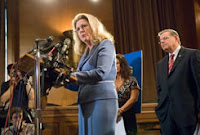 By SUSAN DOWD STONE
Featured Blogger
Judging from the emails I’ve received recently, some clarification would be helpful in understanding who’s on first, who’s at bat and when we may finally see our home run for America’s mothers and infants.
First, you can start by listening to this audio post which explains the basic initiatives of The Melanie Blocker Stokes MOTHERS Act (i.e. MOTHERS Act) which do NOT include PPD screening or medication.
This new audio post includes interviews with Dr. Michael Petriella, OB/GYN from Hackensack University Medical Center; Celeste Andriot Wood, assistant commissioner of the N.J. Family Health Services, and myself, all of us hailing from New Jersey and having worked with PPD legislation as advocates, policy makers and health care practitioners.
This story originally aired on the nationally syndicated program Radio Health Journal in December 2009, and was produced by MediaTracks Communications.
The new Healthcare Reform legislation which just passed in the Senate, is called The Patient Protection and Affordable Care Act. It contains many healthcare initiatives and new policies focused on improving women’s health and ACCESS to healthcare.
The two bills it includes most directly related to postpartum depression are:
The MOTHERS Act (you can read the bill here) which calls for PPD public awareness campaigns, education, research and funding of PPD services sponsored by U.S. Senator Robert Menendez, and The Mikulski Amendment (you can read a summary of this bill here) the very FIRST amendment proposed, passed and included in this bill which calls for screening for postpartum depression (among other women’s medical conditions including cancer screenings). This bill is sponsored by Sen. Barbara Mikulski.
These initiatives are separate bills both of which the Senate approved for inclusion in the Patient Protection and Affordable Care Actm which passed in the Senate on Dec. 24.
But neither of these initiatives would be receiving the public awareness and legislative support were it not for early efforts in the House and Senate to promote postpartum depression research and education. Congressman Bobby Rush has long been a champion of PPD research and education since moved by the plight of his constituent Melanie Blocker Stokes.
Melanie, a beautiful, intelligent mother of a young child with every reason to live, leapt to her death as a result of untreated postpartum illness. Her mother Carol Blocker has waged a tireless campaign to end ignorance. These early champions including Richard and Mary Jo Codey, who dared to look such darkness in the face helped create the initial public platform that led to laws in Illinois and New Jersey demanding more attention to postpartum mental health issues.
Regardless of your political leanings, this bill contains historic emphasis on women’s health care issues. And for those of us who are devoted to ending the stigma and lack of response to the public mental health crisis of PPD, our moment has come. Finally, the science, the studies, the stories and the unimpeachable truth of the devastating and deadly effects of untreated maternal depression are no longer to be ignored to the detriment of millions.
The next step in the legislative process for these initiatives to become law, is for the House and Senate to reconcile the two versions of the bill and send the final version back to both houses for victorious and final passage.
There is every reason to be encouraged that our PPD intiatives will remain intact during these negotiations as the House has previously passed – by nearly unanimous consent – The Melanie Blocker Stokes MOTHERS Act thanks to the decades long efforts of its House leader, Congressman Bobby Rush.
When will this happen? The passage of these initiatives are dependent on the passage of the entire healthcare reform package. It is expected that the intense legislative focus on healthcare reform could result in final outcome by early spring.
Susan asks that anyone wishing to sign a petition supporting the health care bill may sign here.
Wednesday, January 6, 2010
The Man from Glad, Part II
 Below is a video that shows where my journalism career essentially began, but also the moment I took my very first big career risk.
The 1985 interview is with the former governor of New Jersey, Thomas H. Kean, who later became the chairman of the 9/11 Commission. I did it with my friend, Bill Borden, whom I just profiled in this space (see The Man From Glad, which was posted on Dec. 30).
We served as co-editors of the Point Pleasant, N.J. High School newspaper, The Panther Print. Everything went well when Bill and I worked together - even though I was struggling to hide a perpetual giggle throughout the taping.
Just before the taping, I took the daring step of asking the governor to endorse my National Honor Society application. I had been rejected twice before, and I felt I deserved the recognition. Back then, I was a bit of a conspiracy theorist, and I was convinced that certain teachers who didn't like my opinionated ways were working against me.
I was told that anyone could sign the application - which I kept folded in my pocket - as a way of showing support for the candidate. En route to the taping in Asbury Park, N.J., I thought, "Why not Kean?"
I remember the strange look on Kean's face when I asked for it, and handed him the crumpled piece of paper. Bill broke out into full-scale laughter, especially when Kean unfolded the paper and looked very puzzled.
Kean looked at it, showing the same scrutiny he later had when he studied documents from the Bush administration during 9/11 Commission meetings. Then he smiled, and signed it. "As long as I don't get anything in the mail," Kean joked.
After that, the producers of the local cable show had to retake the beginning part of the show three times. Bill and I couldn't stop laughing.
Later, I'll never forget the surprised look on the faces of the teachers who were on the committee that chose honor society members. "Do you want to save a copy?" they asked me. "Nah," I said. That was, perhaps, my earliest attempt to show independence and objectivity as a reporter.
I later got into the National Honor Society, but I credit Bill. I don't think I would have taken that step of getting Kean to sign a crumpled piece of paper if Bill had not encouraged me to take risks, and move out of my shell of shyness.
Shorter youtube version:
Longer blip.tv version:
Saturday, January 2, 2010
Make the best of the winter jeer
 Congratualtions on a new year, everyone.
My condolences, too. It's January.
As years go, now is the hard part.
Thick ice, gray skies and slow-starting cars - all that wouldn't be so bad if we still had more presents to unwrap.
The snow just melted in my backyard. But what was underneath?
A big pile of leaves. Whoops! Those must be left over from the fall. Yeah, I'll get to them by the thaw - or the fall.
For me, as a runner, the worst thing about January is the short day. Trying to fit in a run before it's dark ain't easy.
Sure, I could run at night. But trying to get out the door and look at a dark sky, and feel the bone-chilling breeze, and then run three to five miles? Forget it.
For others, however, winter's short days can be much worse.
They can bring on the symptoms of Seasonal Affective Disorder for nearly 14 million Americans who suffer from this serious disorder.
The New Jersey Association of Mental Health Agencies, Inc. urges everyone to be aware of the signs of SAD and seek medical attention to ensure proper diagnosis and treatment of SAD or other illnesses that may be mistaken for SAD.
“SAD is a real, diagnosable mental health disorder that should be taken as seriously as all other kinds of mental and physical illnesses. It is important to understand that help is available for individuals who experience depressive symptoms, whether they indicate SAD, clinical depression or any other condition,” said Debra L. Wentz, Ph.D., Chief Executive Officer of NJAMHA.
As with depression, symptoms of SAD may include but are not limited to fatigue, lack of interest in normal activities, social withdrawal, difficulty getting out of bed, difficulty concentrating and thinking clearly, feelings of sadness and apathy combined with irritability, excessive sleeping and difficulty staying awake.
The difference is that with SAD, individuals may also experience an insatiable appetite for carbohydrates, which can result in weight gain. In addition, symptoms of SAD usually dissipate when spring arrives and typically do not reappear until late fall when the days begin to get shorter again and especially during January and February. By contrast, symptoms of depression could last or periodically reappear all year long.
“Since both SAD and depression can become serious and SAD could be mistaken for other illnesses, NJAMHA recommends that individuals experiencing these symptoms seek treatment from mental or medical healthcare providers. SAD can be misdiagnosed as severe depression or bipolar disorder or as a physical illness, such as hypothyroidism, hypoglycemia, infectious mononucleosis or another type of viral infection. Therefore, it is critical that individuals who feel they may be suffering from SAD see a doctor and ensure they are properly evaluated and treated,” Wentz said.
For individuals who suffer with SAD, cognitive behavioral therapy (CBT) with a mental health professional can help change negative thoughts and behaviors and can prevent a relapse of SAD symptoms when winter arrives again. Exposure to high-intensity artificial light or use of a dawn simulator, which gradually turns on a bedroom light each morning beginning while an individual is still asleep, also can help ease symptoms of SAD.
In addition, following a high-protein/low-carbohydrate diet and exercising regularly, in front of a light box if done indoors, also can help prevent or alleviate SAD symptoms.
NJAMHA urges everyone to monitor their mental health and that of those around them and to call a community mental health provider if help is needed.
To identify and contact local providers, call NJAMHA at 609-838-5488 between 8:30 a.m. and 5 p.m. during normal business days or visit www.njamha.org (in the left-hand sidebar, select “Need Treatment?” to search providers).
Wednesday, December 30, 2009
The Man from Glad
 For once, I'm not going to write something sad about a fellow high school classmate.
I'm going to write about Bill Borden, who turns 43 today. This is an excerpt from my book, "Generations," a book about my family that, hopefully, you'll see on the bookshelves (will there be bookshelves?) in a few years:
The person who really saved me, at least during my teenage years, was Bill Borden. He showed up at my house, in Point Pleasant, in 1984, wanting to go the beach. Something about that visit made him my best friend, forever, because he never did stop showing up at my house, unannounced, ready to have fun. I saw him as my strongest confidant, and even a savior.
We had known each other before, and we had worked together, too. But from then on, we were best friends. I learned more from Bill than anybody. I marveled at his ability to smile his way through problems. I was struck by his ability to just go up to people, almost randomly, and start talking to them. I was amazed at how little he would say, but he could somehow carry on a conversation with anybody – particularly women – for hours.
I was always too shy and cynical to be social. I felt insecure about the way I looked. I felt embarrassed about my family. Bill had a similar background, but he didn’t care about any of that. He was a slender, but strong kid who talked slowly and had an awkward, but honest and even charming way about him. He was a smart guy who did some silly things. Once, he read a dense geopolitical book from Ayn Rand in one day. Other times, he'll shave or shower right after a late-night party. I can always imagine him saying to those who question him about it, “I have to get clean. I have to go to work next morning."
Bill’s mission was to have fun, to smile and to live a good life. Bill had no lofty expectations for himself; he just wanted to work hard and go to bed, and then wake up the next morning and do it all over again.
Bill's family had problems, too, the kind of problems every family has. He always found a positive way to look at things, and he always believed there was a solution to everything, even when everything seemed to be falling apart.
With Bill, I learned how to keep friends. I was too embarrassed by my own family life to invite them over, and have them bear witness to my mother getting one more “will you love me forever and ever?” out my father. I didn't want them to see her limp, and I certainly didn't want them to eat her food. But Bill didn't care. When he showed up at my door, during the summer of 1984, he just walked in and talked. He stayed for a good hour, talking to my mother and father, letting a warm, sunny day go by. He even had a sandwich, one that contained my mother’s thick, grisly meat loaf, and swallowed it nearly whole before finally we got on our bikes and headed for the beach. He built a bond that day with my parents and, as a result, with myself that would never go away.
With Bill, I felt like I finally had an equal. I no longer had to stand in the shadow of my family. I no longer had to depend on people who viewed life as a chore. When we were intense, he would be laid back. When we'd rush, he'd be methodical. When something upset us, Bill would brush it off. The more he came to my house, the more his attitude seemed to rub off on the others.
He made my mother laugh as hard as anybody. She seemed to be comfortable with him, too, and she even asked him some probing, personal questions. “Are you still dating Diane?” my mother would ask, and he Bill would then break down the history of the relationship before getting to the point.
Bill sometimes offers non sequiturs that would leave all of us hunched over, and laughing, largely because he misheard or misinterpreted something we said.
“So what you doing tonight?” she once asked Bill while sitting in the kitchen, a tall glass of beer and a bag of potato chips sitting in front of her.
“No thanks – I just had steak,” Bill replied.
My mother laughed for a long time, and didn’t get close to her beer for nearly a half-hour. For many years, she still talked about that exchange, and repeated it over and over, like it was the funniest thing she ever heard.
Tuesday, December 29, 2009
A tough time in a tough decade
 Few memories in my life could remain so vivid: Stepping off the PATH train, and walking what seemed like 20 blocks to the smoldering ruins of the Twin Towers, and breathing in the burning smell of God-knows-what.
It was Sept. 12, 2001, the day after. I was supposed to write a story on the PATH service, and how commuters were coping with the worst tragedy of their lives. Then I was to head south, and perhaps help with the news coverage down there.
But I had little interest in working. I just wanted to see Ground Zero, otherwise known as "the pile;" the day before, I saw Tower One fall, and crumble into a pile of beams and ash, as I drove north on the New Jersey Turnpike. I saw people with video cameras parked along the road, trying to squeeze some glimpse of history in between videos of their family memories.
But, on Sept. 12, as I walked down there, and I got closer, I saw images that seemed to stand out more than "the pile" ever did. I saw people walking around with posters, saying, "Please help me! Have you seen her? Please, can you help me?" They were like the people I used to see at airports who handed out brochures, saying there was "no tomorrow," and "God will be there to save us...believe in him."
To say it was surreal would be cliche. Simply, it was the most depressing thing I ever saw.
I tried to walk past the people, and get to the pile; instead, I just stood there, and saw the people walk around like zombies, holding the pictures close to their chests, or high over their heads, looking so helpless and hapless.
I somehow knew that they would never find those people; what I didn't know was that, eight years later, many of them still seem to be looking for the loved ones they lost, and they're still struggling with the idea that they'll never come back, and that their lives will never be the same.
Back then, I thought I was in another country. This was the United States, I thought, a country with bravado. This was a country that pushed the Germans back on D-Day, and eventually all the way back to Berlin. This was not a country where people look for someone to constantly reassure them, and tell them, "It's OK. Everything is OK. We'll get the bad guys. It's OK."
It's a memory I'll never lose, even as we, as a country, seem to be so detached from it now. Even last week's near-terrorist attack on a Detroit-bound jet didn't seem to ignite the feelings of vengeance that drives people's anger when they've been attacked.
But, in other ways, we're a nation that's still hurting. When we hear about talk of the economy, and we see the poll numbers showing a falling level of confidence in government, I wonder if it has more to do with nation's soul that was wounded eight years ago, and never really recovered from it.
I think that were less detached than we think from the zombie-like atmosphere that I saw in lower Manhattan eight years ago, and we're still looking for some hero to tell us, "It's OK. America will do fine. It's OK."
I've written a lot in this space about the services available for people who are suffering from post-traumatic stress disorder, particularly people who were victims of 9-11. But, in a way, I feel like we're all suffering from nationwide PTSD, and we're still looking for some something to heal ourselves, and give us a chance to move on.
I think we're still looking for some ticker-tape parade, something that will declare that not only are the wars in Afghanistan and Iraq over, but it's OK to shop again, and it's OK to buy things again, because we're no longer spending money to fight wars against terrorists we can't see.
We're looking for some finality to the worst moment of our lives. But it never came, or it hasn't come yet; indeed, it's only escalated now that President Obama has sent in another 30,000 troops to fight the terrorist war in Afghanistan. It's only continuing when someone somehow finds a way to get the components of a bomb aboard a plane, and comes within minutes of creating our worst tragedy since Sept. 11.
In my personal life, it's continuing because I lost a friend. He's not dead, but he had a business in the World Trade Center that was obliterated when Tower One fell. Rich Kelly, another old Point Pleasant Borough high school buddy of mine, was a hero that day because he ordered people to run to Battery Park, and avoid getting buried under the crush of steel and ash.
The problem, however, was that no one was there to save Rich. Afterward, he tried to recover, buying himself a Porsche and taking me on a ride through Colts Neck, N.J., speeding up to 90 mph on some of the old, two-lane roads that run through one of the state's wealthiest communities. But he ran into trouble as he tried rescue his business life.
I tried to help, but he resisted, to the point that he virtually shut off contact with me. Rich always thought he'd be a millionaire by the time he was 30. Last I heard, he was working around the clock, selling phone systems to businesses and still trying to recover that dream. Leaving him a phone message, or sending him an email is pointless. He won't return any of them.
A lot of people blame President Obama for doing little to turn the nation's confidence around. I don't fall into that category. Mostly, however, I look forward to this new year and new decade. I've heard people talk about the 1960s and 1970s, and how they looked forward to the end of those troubled times just by looking at the clock.
Perhaps time is our only ally here, and we can hope that a new decade will inspire hope. We can hope that people will find a way to get through their trauma, and that they'll find a way to move on as we move farther and farther away from 9-11. We can hope that someone can provide more services, or better services that people can use to help themselves. Or, maybe people find a way to have better access to those services, wherever they may exist.
We can hope that people like Rich can dream of being millionaires again. But if they can't, then maybe they can come to grips with who they are, and perhaps play a role that can inspire people, the same way Rich inspired people to run away from the falling tower.
Tuesday, December 22, 2009
Keep your holiday cheer at this time of year
 The holidays are portrayed as a happy time of celebration. But it's not true for everyone - especially those who have mental illnesses, and even more so in today’s economic climate.
One of every four residents has a mental illness, such as depression or anxiety, which can be exacerbated during the holiday season and further intensified in reaction to financial stress, mental health professionals say.
Regardless of the time of year or the economy, it is critical to manage mental and physical health, recognize signs of mental illness and seek help when needed.
Anyone could experience holiday blues, especially if they experience high levels of stress. During this time of year, stress is commonly related to having unrealistically high expectations for the holidays, said Debra Wentz, chief executive officer of the New Jersey Association of Mental Health Agencies, Inc.
"But this year, it could be even worse because of the turbulent economy,” she said. “It is vitally important for everyone to take steps to manage their stress levels, which can greatly impact both mental and physical health.”
Stress can be reduced by managing what can be controlled. For example, expenses, such as gifts and entertainment, can be reduced. Healthy practices, such as exercising, eating right and getting enough sleep, are also helpful in managing stress, in addition to offering many physical health benefits, professionals say.
Stress and depression can also be related to increased use of alcohol or drugs, especially for individuals who are in the early stages of recovery from addictions. The holidays, with the accompanying stress or social more situations, can also lead to increased drug or alcohol use, professionals say.
Professional help may be needed if any of the following signs become evident:
- persistent sad, anxious or “empty” mood;
- changes in sleep patterns;
- reduced appetite and weight loss, or increased appetite and weight gain; and
- loss of pleasure and interest in once-enjoyable activities; restlessness or irritability.
It is important to realize that most of these symptoms also indicate holiday blues, professionals say. However, holiday blues will dissipate when the season ends and people return to daily routines and no longer experience holiday-related stress. By contrast, depression is indicated by these symptoms lasting for two weeks or longer.