 By SUSAN DOWD STONE
Featured Blogger
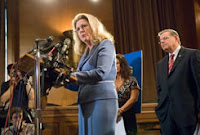
The historic passage of Healthcare Reform also makes history for America’s mothers as language from The Melanie Blocker Stokes MOTHERS Act becomes LAW!!!
Finally, the plight of millions of American women, infants and families has been acknowledged and the tide forever turned! With this long sought federal mandate, states will find more support for PPD programs, researchers will find funding encouragement to continue their search for etiology and cure, and communities will harken to respond to this unmet need. Grants will be made available to fund a variety of entities and programs charged with caring for women suffering from postpartum depression.
There are no words to express our collective gratitude to the following individuals who began this march oh so long ago. Each step was filled with conviction, tears, controversy, guts, belief, outrage, setbacks and hope. And tonight, we can all begin to feel that at long last the doors and hearts of America are open to the maternal suffering that may no longer be silent and stigmatized.
To U.S. Senator Robert Menendez, you are an unwavering champion of the women and infants you represent. Against all odds, you never once set aside this initiative. You are not the Senator from New Jersey, you are the Senator of America’s mothers.
To NJ Senate President Richard Codey and the courageous Mary Jo - beloved by all for taking on the most difficult role of her life – with your example, your stigma busting campaign and your groundbreaking state legislation, you set the bar for our nation to follow. “Speak Up When You’re Down” she said. And women have not been silent since.
To Congressman Bobby L. Rush, who brought the House to its feet with near unanimous consensus and forceful leadership on this issue, your unfaltering crusade has led us to this moment. Without your work, your belief, our voices would still be murmurs of closeted shame. You are the change you sought, you live the life you lead others to believe in.
And to Carol Blocker, who has walked a million miles to share her story of incomprehensible heartache so that others might be spared excruciating loss, know that Melanie Blocker Stokes lives not only in the eyes of Somer Skyye, but in every program and community which will safeguard their mothers. We Thank God for Carol’s advocacy.
Each one of us is aligned with one or all of these heroes. Be it through motherhood, fatherhood, childhood, advocacy, organizational and individual support, a foundation born of tragedy, experience, research, blogging, writing, singing, creating, art, music, medicine, psychology, non profit leadership, endurance, courage, community action or voices in unison, you have all indeed made a life saving difference.
And for every mother and child lost to this illness…every square on Postpartum Support International’s Memory Quilt…. read each year by PSI’s Founder Jane Honikman…you are not forgotten and your life continues to infuse helping, caring spirit throughout the community of motherhood.
To every person who signed the petition, know that your signature was seen; that it carried weight. From Congressional offices to Qunnipiac pollsters, the petition was read and referenced again and again. You fearlessly listed your names, dared to make your stand known, and said, Enough is Enough. You have won. Thank you for your virtual presence, your letters, your phone calls, your support, your persistence.
Below is the language included in tonight’s Senate Bill which will now become law. Note that it does NOT mandate screening OR subsidize medication. The breadth and depth of the services encouraged and supported by its initiatives open the door to programs from concrete services to help new mothers, to education, public awareness and support, research and access to treatment.
When we began this journey, we did so with the acknowledgement that the experience of motherhood is apolitical, universal in its reach. Tonight, let that shared love and reverence reach above political differences and prevail in this celebration of life-saving victory for America’s mother, infants and families.
Monday, March 22, 2010
Health care for postpartum depression


Tuesday, February 16, 2010
Trick or treat? Nope, says the government. April fools!
 You gotta wonder when a governor says he's going take a pumpkin scooper to a state budget, and scrape so much out that there's nothing left but the mushy skin.
Well, welcome to New Jersey, where it's Halloween year-round because the state's fiscal picture is a never-ending horror show.
Every year, it's the same thing: Governors somehow find money for programs they can't pay for. Or they cut money for programs that people need. Or they double-talk people into telling them that they didn't raise their taxes when, in actuality, they did just that (trick or treat!).
This year, New Jersey's Governor Christie has a laundry list of things he's slashing with his large budget axe. There will be cuts to state aid to schools (geez, you gotta wonder if that's going to lead to property tax increases, no?). There will be cuts to higher education.
And, of course, there will be cuts to everybody's favorite target: Aid to services that care for the disabled and the ill.
Take New Jersey’s reductions of reimbursement rates to pharmacies serving Medicaid beneficiaries. As a result, small pharmacies won’t carry all prescriptions and patients will be discouraged from getting them filled.
Any increase in state revenue from co-pays would be dwarfed by the inevitable costs of emergency treatment, hospitalization and other services to treat individuals whose conditions worsen because they discontinue medications, Debra L. Wentz, chief executive officer of the New Jersey Association of Mental Health Agencies, Inc.
“Co-pays and reimbursement reductions impose a barrier for individuals who already struggle to pay for rent, food and utilities," Wentz said. "The state should not further burden them with co-pays, forcing them to choose between prescriptions and other needs."
Ultimately, untreated mental illness, whether due to an individual’s inability to pay for medications or lack of access to treatment, inevitably costs the state billions of dollars every year.
As a result, the state loses approximately $5.6 billion each year in lost productivity.
“In these difficult economic times, funding for any type of program or social service could be on the table as a potential budgetary cut," Wentz said. "It is unconscionable to force individuals with mental illness to forego treatment and face dire consequences in their lives, which can include not only hospitalizations, but also homelessness or incarcerations – and these consequences are also very costly to the state."
It's the kind of thing that makes me feel like we're living in a world of helplessness, that the only solution to everything is to cut, cut, cut until the backbone of society breaks in half. We look for inspiration in our political leaders; instead, we're left as victims of fiscal larceny, forced to give back when we really need to give more.
I've been listening a lot to the legendary comedian Bill Hicks lately. Bill died at 32 of pancreatic cancer, but he left a mark as one of the greatest stand-ups of all time.
Bill patterned his act after Richard Pryor: Neither of them claimed to tell jokes for a living. Instead, they said, they were just talking. They talked off the top of their heads, and much of what they had to say was cynical. But, mostly, Hicks' commentary, mixed with absurdity, was thought-provoking and on-target.
I'm no socialist, but his proposal for curing the world's ills, in the below video, makes more and more sense the more I listen to it, and the more I see failure in the eyes of society.
Tuesday, February 9, 2010
The new health care revolution: a coming co-pay revolt?
 When I saw Brian Anan for the first time in many years, I was impressed by how he looked, but more shocked by what he had to say.
I still find it remarkable that I get this insecure feeling whenever I hear of a friend who's on meds. I feel terrible for being that way, but I can't help it. Some prejudices are just too hard to shake, even when somebody tells me how much the drug, Lexapro, has saved their life
Luckily, but not so lucky for him, Brian had other news that upstaged everything he said before, and quickly wiped my prejudices away. It was news that converted whatever insecure impulses I may harbor about medication and mental illness into justified anger.
I asked him how much this drug, an anti-anxiety medication, cost him.
"You wouldn't believe it," he said.
"Try me," I said. "I've heard stories."
"One-hundred-and-eighty-dollars."
"How much?" I asked. "Don't you have insurance?"
"Yeah," Brian said.
"THAT is your co-pay?"
"Yeah, just the co-pay," he said. "Even the people at Walgreen's were stunned...It was the first time a pharmacist's assistant ever said, 'Are you sure?' "
His company had just switched insurance plans, and this is what they left him with. An insurance plan that doesn't insure.
That made me think of health care, and how the politicians who run our country still can't get it right. They still can't get a floor vote in Congress on even the weakest of reform plans.
I've seen the tea-baggers and other conservative forces erupt in protest over the Obama administration's attempts to, in their words, lead a government coup of health care. I've seen liberals unjustifiably dismiss this movement as nothing more than, pardon the metaphor, a lunatics-running-the-asylum moment.
But I wonder if another revolution could be in the works. How many other Brian Anans are out there who will feel the same sticker shock when they go to their drug store and see how much they have to pay?
They're already paying nearly $1,000 a month for the health care plan itself, the same money that could go toward a month's rent. Now the meds that keep them alive, or maintain their sanity cost nearly as much as a car payment.
If they keep a budget, something's going to have to get cut. It may be easier to cut the pills than the car.
You gotta wonder how much longer a country can go when it's paying for medical insurance that has little-to-no competition. You gotta wonder how much longer people can last when they can't find the room on their credit card to pay for a co-pay.
Just a few years ago, Brian was paying $10 for the same medication. You gotta wonder why the pro-reform forces can't see this, and how their own campaigns for change repeatedly miss the point.
They consistently point to the 40 million people who don't have insurance. But what about the tens of millions who have it now but, they're learning quickly, can't afford it?
Many of those people are in the great middle-class, the same ones who are supposedly up-in-arms about any talk of a government takeover of health care. They're also the people who vote, and when they vote, they often vote with their wallet. Will they vote for their co-pay?
Brian's not so sure. For now, he'll pay the bill. After a life of living with eating disorders, he finally looks like he's found some security. His keeps in shape, but doesn't overeat. He's got a family and a decent job.
But if his co-pay can go up 1000 percent in just a couple years, what's next? What will he have to sacrifice if no change takes place?
"I'll remember this in November," Brian said. "If I don't see any legitimate options out there, I'm going to blame somebody."
Wednesday, January 20, 2010
A year later, it's a barren land
 I'm sitting in the Senate Press Gallery, looking out at a Washington street that's as empty as I feel.
I remember a year ago, almost to the minute, when I was nearly stampeded by throngs of crowds out to see President Obama's inauguration. I think about the promise of that day, and how America seemed to be changing for the better.
It didn't matter if you were Democrat or Republican - which I am neither. You had to feel something good about a black man being elected president. You had to feel something good about change, much like many people felt in 1980, when Ronald Reagan was elected.
Back then, in 1980, just as it was (and still is) in 2008, our country was in rut. As silly as this sounds, it didn't matter if Reagan's policies were good or bad for the country.
For many, hearing Reagan's strong and powerful voice was as exciting as seeing Obama project an image of equality and opportunity. In both, you had a feeling that America's image had changed for the better.
But now, as I look out at the street, the positive feelings are only fleeting. I can now only think about what was lost, or what could be lost, especially after the Democrats lost their 60-seat majority last night.
In the background, I can hear Sen. John McCain railing about how health care brought down the Democratic candidate for Ted Kennedy's Massachusetts seat, leading to Republican Scott Brown's election. He's probably right, but I still believe it wasn't the policy that was the problem.
It was the execution, and it was the leadership.
Millions of people stand to remain uninsured, and those who are insured are nearly certain to face rising co-pays for medication and doctor's visits, largely because the man who promised to bring us help couldn't capitalize on his potential to inspire.
People with mental illness stand to pay $50, or maybe even $100 for a bottle of anti-depressants because the man who promised to bring us help couldn't find a way to craft a vision that people understood, or even liked.
I remember Reagan getting Congress to pass tax cuts in the early 1980s, and doing it in a way that, perhaps, should be described in whatever textbooks are out there that have this theme: "How to be a successful politician."
Ten years before Ross Perot did it, Reagan went to the people. He got on the television, pre-empted prime-time programming, pulled out pie charts and showed everybody why, he felt, tax cuts would save the economy.
Whether the tax cuts were effective or not is another argument. His politics were genius, and he articulated a vision for the country on those nights that inspired thousands, maybe millions of people to call their congressional representatives and get them to pass the tax cuts.
He did it, even though the policy wasn't very popular. By 1984, however, it was very popular, and Reagan was elected in a landslide.
If there is any hope left for saving health care, the man who inspired many like Reagan did 28 years before needs to understand what the 40th president and former actor knew, and knew well: You can't sell the policy without the politics.
You can't live up to your potential if you can't learn to lead.
Monday, November 9, 2009
The life and art of Kimberly Green
 Last week, I wrote a well-received blog on Kimberly Green, a woman who's suffering from stage 4 breast cancer, but nonetheless has sacrificed so much of herself to give to so many others.
I was particularly impressed with her organization, the Green Family Foundation, and the work it's done in Haiti with the Clinton Global Initiative and President Clinton. I saw the pictures of the kind of work her foundation performs, and I saw the close relationship the organization has had with Clinton in bringing health care to a health-ravaged nation.
What bugged me was when I did a Google search of Kimberly's work, and I did an additional search of her foundation's association with Clinton. I came up with next-to-nothing.
This blog entry is an attempt to bring it all together. Below are clips of a slideshow I put together that includes clips of the foundation's work in Haiti. The show is accompanied by a voice-over narration of my blog post from last week, spoken by me.
This is an all-attempt to get the Internet to recognize the good work that these people do. This is also an attempt to show that the work the foundation does isn't done in a vacuum. It's attracting help from the most powerful people in the world.
It's time to recognize the Green Foundation for what it is and what it has done.
NOTE: The Green Family Foundation has a Facebook page that can be found here.
Thursday, November 5, 2009
What can be done about health care?
 If you don't understand health care, then maybe you should see somebody who is sick.
Like Kimberly Green.
She's had breast cancer for more than three years. Her treatment costs $6,000 a month. Without it, she said, "I would die."
Myself, Kimberly, some fellow bloggers and health practitioners got together a few weeks ago to talk to her, and to talk about her.
But we also talked about a health care system that's broken. Tens of millions of people are without health insurance, all lacking what she's got that's kept her alive.
As much as we wanted to know about Kimberly, we acted as though we were going to solve this health-care problem ourselves, and we hoped to solve it within a 90-minute span. We didn't get there, but at least we had a healthy dialogue that - if the Obama administration is listening - produced some ideas for finally getting efforts to pass health care reform off the dime.
Click on the below photo to get a glimpse of our Healthcare Reform Blogger Roundtable in New York City, and learn about how Kimberly's work with the Green Family Foundation that has emboldened her to be aware of her environment, and to not take life for granted.
Then, listen to what we have to say (I'm the one sitting against the wall with a tie).
NOTE: The Green Family Foundation has a Facebook page that can be found here.
Thursday, October 29, 2009
Give her health insurance, or give her...
 When it comes to health care, Kimberly Green doesn't get it.
Oh, don't think for a minute she doesn't know anything about sickness. She's had breast cancer for more than three years. She's had highs and lows, but she knows that wellness can only last for so long when you have stage 4 cancer.
Green - like much of the country - could be one health crisis away from financial ruin. What she doesn't get is why so many people just don't understand.
Her treatment costs $6,000 a month. Without it, she said, "I would die."
Green shakes her head when thinks about it. Tens of millions of people without health insurance, all lacking what she's got that's kept her alive.
Now, as the nation debates how to finally deliver health care to those who need it, Green isn't afraid to use herself - and her words - as a vehicle to convey a message that, she believes, much of the country still has a hard time understanding.
Give them treatment, she says. Or they will die.
"There are a lot of things that can help people, but these things should be available to everybody," Green said.
Green's family has understood this for a while. They have a foundation that's dedicated to improving global health and elevating socioeconomic conditions in impoverished countries.
The Green Family Foundation, a private, non-profit organization, has worked with the Clinton Global Initiative in benefiting Haiti. Just recently, the foundation committed more than $280,000 to improving villages and restoring the country's musical heritage. The foundation also provided a $10 million gift to Florida International University - including a state match - to fund a community medicine program.
Green, speaking at the foundation's Healthcare Reform Blogger Roundtable on Thursday, said her family's work has emboldened her to be aware of her environment, and to not take life for granted. She has made a number of trips to Haiti, appearing with former President Clinton in photos and seeing the worst that poverty can bring.
There, she once saw a woman whose breast was very enlarged. She knew it was breast cancer, but she asked one of the doctors: What will happen to that woman?
"It will be cut off," she said, recalling what the doctor told her. "She will die."
This is a life without health insurance, she realized. And it was the kind of image that inspired her - after her mother was diagnosed - to get a mammogram. Her cancer was diagnosed soon after, and she underwent treatments. She sorted through options until she found what worked best for her.
But when she thinks of the health care in the United States, she thinks of that woman. Costs are rising. Drugs are becoming less accessible. She's worried about how bad things can get. She wonders if we're not so far away from facing the same consequences.
In the United States, at least, many people like Green have choice. But many do not. How long?
"I don't know why it has to be this way," she said.
NOTE: The Green Family Foundation has a Facebook page that can be found here.
Wednesday, August 26, 2009
Ted Kennedy and mental health care
 As flawed as he was, the real, true hope for mental health parity came, and went, with the late Massachusetts Sen. Edward "Ted" Kennedy.
Though Congress passed mental health parity into law, it's useless legislation for the millions of Americans who don't have health insurance. Many of those have a mental illness that prevents them from having a job with a stable income, and a house with running water.
The only hope rests with the Obama administration, and if it can carry the torch - and emphasize the importance of having health care for all - from the man who once famously declared that the "dream shall never die."
Saturday, July 4, 2009
Mental health care independence
 Every time I hear any mention of health care, I recoil in horror.
The old conservative feelings in me come out, and I wonder if this is just another blown kiss to industries that support political causes.
I think about the 2000 presidential campaign, when Al Gore talked about health insurance as a "right," not a privilege, and how he wanted to put the nation's security in a "lock box."
Every time he said it, his face contorted in such a phony way that, well, it's no wonder Darrell Hammond from Saturday Night Live did more to destroy his campaign than Al Gore himself. He was such an easy target for imitation.
In this case, imitation was the most sincere form of abuse, not flattery.
On Independence Day, however, I'm not thinking about politicians and promises and tax increases. I think of those who are too dependent on others to stand on their own.
I think of people with mental illness, the people who can't find the same access to medication as Michael Jackson.
If government is going to do anything, maybe the politicians need to only think of the people who are too brain sick to make independent decisions. They're too ill to understand the importance of holding down a job, and get the kind of therapy they need.
When we think of those who died for freedom, perhaps we should consider that they died so everybody could be free to make their own choices to protect their health.
Tuesday, September 9, 2008
Time to take steps to ensure mental health parity
 The National Eating Disorders Association has issued the following alert:
Call-in day for passing mental health parity is this Wednesday Sept. 10. The NEDA wants people to call their members of Congress.
From the NEDA:
Action: On Wednesday, Sept. 10th, you should call your U.S. Representative and Senators by using the toll-free Parity Hotline: 1-866-parity4 (1-866-727-4894). The Parity Hotline reaches the U.S. Capitol switchboard which can connect callers to the offices of their members.
If you don’t know who your senator is, you can simply tell them your state and they will connect you. For your representatives, go to www.house.gov and then enter your zip code – this will identify who your Representative is.
Targets: All members of the Senate and House.
Message: "I'm calling to ask that the senator/sepresentative urge the congressional leadership to pass mental health and addiction parity legislation this month before Congress adjourns."
Background: The House and Senate committees of jurisdiction reached an agreement on the language of a good parity bill that will be brought to the floor of the House and Senate (H.R. 1424 and S. 558). First, however, they must agree on the source of $3.8 billion in offsets ("pay-fors" over 10 years) required under the Budget Act.
Friday, July 18, 2008
Suffering from cancer, but still a force
 Sen. Edward Kennedy has drawn much criticism in his long life, but few debate his skills as a senator - particularly his ability to bring opposing sides together to pass critical legislation.
And no one, it appears, argues with commitment toward making a difference in legislation - even as he suffers from brain cancer - that would help people with mental illness.
Debra L. Wentz, head of the New Jersey Association of Mental Health Agencies, Inc. noted that Kennedy has continued his lifelong commitment to protecting the health and well-being of seniors and disabled citizens by rallying to block Medicare fee cuts and to push for a mental health parity bill.
Congress recently passed the latter bill, which awaits President Bush’s signature by the end of this month.
Wentz said these efforts are a fitting testament to the impact Kennedy has had on health and mental health care throughout his life.
"We will be hard pressed to find another advocate who is equally skilled at garnering bipartisan support for vulnerable populations, as well as the elderly,” she said.
Wednesday, January 9, 2008
Insurance companies strike back ... so beware
 Should it be any surprise that the primary foe to mental health parity is big business?
Just ask Christine Stearns, vice president of the New Jersey Business and Industry Association, who says the insurance industry should be spared from contributing toward mental health treatment.
With health insurance costs rising at four-times the rate of inflation, New Jersey should not require employers to pay for "virtually unlimited coverage" for treatment of substance abuse and a wide range of behavioral problems, Stearns says.
Stearns said New Jersey employers saw their health insurance costs rise by a cumulative 55 percent in four years (2001 to 2004). Businesses participating in NJBIA’s 2005 Health Benefits Survey reported paying an 11 percent average increase in the cost of providing health insurance to their employees in 2004. Their average cost was $7,300 per employee.
Adding new mandatory coverages at a time when employers cannot even keep up with current health insurance cost increases is "bad public policy," Stearns says.
“Many employers have reached the breaking point," Stearns says. "Imposing this mandate will cost real people all of their health insurance benefits. Not only will they have no access to treatment for behavioral disorders, but they will lose coverage for hospitalization, prescription drugs, doctor visits, blood tests, and everything else.”
Furthermore, insurance plans are already required to cover serious mental health illnesses and most insurance plans already provide coverage for substance abuse, although not the unlimited coverage that would be mandated under A-807.
“It’s not just a question of whether or not employers should provide this coverage,” Stearns said. “It’s a question of priorities. Should we require unlimited treatments for
Stearns also says such a mandate would not apply to all insurance plans; only those sold in the state’s regulated market, which insures only about 2.4 million residents. Almost all small businesses (those with two to 50 employees) that provide health benefits are in the regulated market, so this mandate would be imposed on the small employers who would be least able to afford it, she said.
But Debra L. Wentz, chief executive officer of the New Jersey Association of Mental Health Agencies, Inc., says mental health insurance parity would provide stability for employers who routinely deal with staff-level emotional and behavioral issues.
“Treatments for mental illness have been proven effective and can help individuals achieve a fulfilling life of recovery. However, there are many barriers, including inadequate funding and stigma, that prevent children and adults from receiving the therapy and other support services they need,” she said.
Pink Floyd - Mother Lyrics
Mother, do you think they'll drop the bomb?
Mother, do you think they'll like this song?
Mother, do you think they'll try to break my balls?
Ooooowaa Mother, should I build a wall?
Mother, should I run for President?
Mother, should I trust the government?
Mother, will they put me in the firing line?
Ooooowaa Is it just a waste of time?
Hush, my baby. Baby, don't you cry.
Momma's gonna make all of your nightmares come true.
Momma's gonna put all of her fears into you.
Momma's gonna keep you right here under her wing.
She won't let you fly, but she might let you sing.
Momma's gonna keep Baby cozy and warm.
Oooo Babe.
Oooo Babe.
Ooo Babe, of course Momma's gonna help build a wall.
Mother, do you think she's good enough,
For me?
Mother, do you think she's dangerous,
To me?
Mother will she tear your little boy apart?
Ooooowaa Mother, will she break my heart?
Hush, my baby. Baby, don't you cry.
Momma's gonna check out all your girlfriends for you.
Momma won't let anyone dirty get through.
Momma's gonna wait up until you get in.
Momma will always find out where you've been.
Momma's gonna keep Baby healthy and clean.
Oooo Babe.
Oooo Babe.
Ooo Babe, you'll always be Baby to me.
Mother, did it need to be so high?
Saturday, October 20, 2007
Talkin' about a revolution...in mental health parity...well, sort of

In New Jersey, a revolution in mental health parity is taking place. But it's almost a revolution by default.
The General Assembly in Trenton is supposed to post a mental health parity bill in the lame duck session this year that could finally bring about long-needed equalization of insurance benefits.
But the road to get here has been long and rocky. And unnecessary, really.
And mental health advocates don't understand why Trenton politicians fail to sense the growing public desire to do something to help people who suffer from postpartum depression, schizophrenia and other disorders.
People see the impact of these disorders on city streets. Many people who can't afford to get treatment self-medicate by using illegal drugs and alcohol. Their addictions cost them their lives, their families and their homes. Many end up homeless, or in jail.
"Equalization of insurance health benefits to properly cover mental disorders including substance use disorders is right and just," said Joseph Napoli, immediate past president of the New Jersey Psychiatric Association. "It is also cost-effective. The present inadequate coverage for these disorders is penny-wise and dollar-foolish."
Napoli is cautiously optimistic that the legislature will finally act. But mental health parity is not a new idea in New Jersey. And every time it's been given a chance to work, something gets in the way that defeats it - or weakens it.
In 1999, for example, New Jersey passed a parity law, but in a final compromise, the required health benefit coverage was limited to "biologically-based" mental disorders and excluded substance use disorders.
This has created a loop hole that insurance companies have used to deny coverage, says Napoli.
He noted that Aetna and Horizon inadequately cover care for New Jersey residents who suffer from anorexia nervosa because these insurance companies have decreed - contrary to scientific evidence - that anorexia nervosa is not "biologically-based."
Although the present law lists eight "biologically-based" mental disorders, anorexia nervosa is not among them.
"We can easily count the numerous ways that we all pay dearly because insurance companies refuse to cover these disorders at the same amounts and limits that apply to other disorders," Napoli said. "Insurance companies' costs are greater for general medical conditions complicated by mental disorders."
Hope re-emerged in 2002, when N.J. Sens. John Matheussen and Joseph Vitale sponsored a parity bill that would eliminate the loop hole. Assemblywomen Loretta Weinberg and Mary Previte sponsored a companion bill. Unfortunately, Napoli noted, the state budget crisis torpedoed these bills.
In 2006 Sens. Vitale and Barbara Buono and Assemblyman Robert Gordon, among others, re-introduced the parity bills. In December, the New Jersey Senate passed S807 with a vote of 29 to 9 - despite Governor Corzine's opposition.
In May, the Assembly Appropriations Committee voted the bill out of committee. Five months later, the bill is pending in the General Assembly
Napoli is hopeful that some action can finally be taken. So-called shrewd lawmakers, however, pushed any consideration of it until after the fall elections. Apparently, legislators must believe that support of this legislation could be used against them in an election campaign.
And support is not a guarantee, given Corzine's prior opposition to parity legislation.
Right: Dick Codey
But New Jersey is home to Senate President Dick Codey, the former acting governor who became a national symbol for championing mental health causes on a political level and bringing more money and attention to mental health programs.
Oh, and by the way, he also happens to have the highest approval ratings of any public official in this state.
To Napoli, the whole thing is dumbfounding.
"How can we allow this discrimination against individuals suffering with mental disorders, including substance use disorders?" Napoli said. "We need parity now."